An electricity bill fits on two pages, yet it mixes four very different things: what you pay to be connected, what you consume, the taxes and VAT. As long as these blocks stay blurred together, it is hard to tell whether your contract is the right one. We manage homes around Montpellier, many of them supplied by the CESML rather than EDF, and every time a tenant moves in the same question comes up: which supplier, and which option?
Below, we go through the bill line by line, then explain the difference between the regulated tariff and a market offer. A real bill from the CESML area then shows what switching to the Tempo option can change.
The four blocks of an electricity bill
The standing charge
This is the fixed part, payable even if you consume nothing. Its amount depends on the subscribed power (3, 6, 9 kVA and so on) and on the tariff option. A power level that is too high for your needs costs you every month; too low, and the meter trips as soon as the oven, washing machine and water heater run at the same time.
Consumption
These are the kWh read by the meter, multiplied by the price per kWh of your option: a single price on the Base option, two prices on peak / off-peak hours (heures pleines / heures creuses, HP/HC), six prices on Tempo. With a Linky smart meter, readings are sent remotely and the bill relies on actual readings rather than estimates.
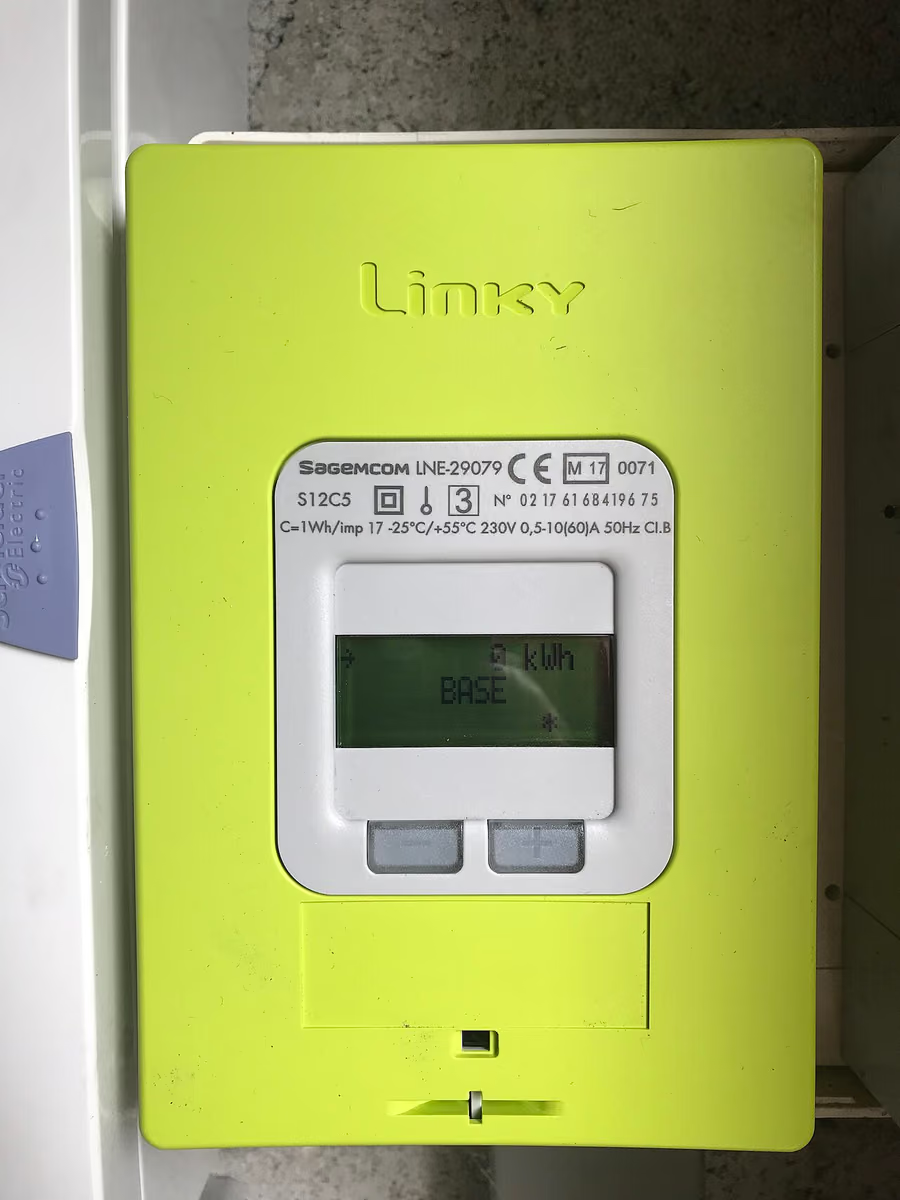
Linky meter. Photo: Benoît Prieur, CC0, via Wikimedia Commons.
Taxes
Two lines appear on every bill:
- The excise duty on electricity (accise sur l'électricité), formerly known as TICFE and then CSPE. It is charged on every kWh consumed. For a household whose power does not exceed 36 kVA, it stood at €0.03085/kWh from 1 February 2026, then €0.03062/kWh from 1 August 2026.
- The transmission tariff contribution (contribution tarifaire d'acheminement, CTA). It funds the pensions of employees in the electricity and gas industries. It is calculated on the fixed part of the network tariff (the TURPE, paid to the grid operator), not on your standing charge. Its rate has been 15% since 1 February 2026, compared with 21.93% previously.
VAT
Since 1 August 2025, VAT is charged at 20% on the whole bill, standing charge included. Previously, the standing charge and the CTA benefited from a reduced 5.5% rate.
Why the total including tax is not the pre-tax amount plus 20%
The excise duty and the CTA are added to the pre-tax amount, then VAT is applied to the whole, taxes included. On the real bill detailed below, €199.41 before tax becomes €310.20 including tax: €59.09 of taxes, then €51.70 of VAT. The gap therefore reaches 55%. To compare two offers, always reason in amounts including tax, based on your own annual consumption.
Regulated tariff or market offer: what sets them apart
The regulated electricity tariff (TRVe)
The tarif Bleu, to use its commercial name, is set by the ministers responsible for energy and the economy, on a proposal from the Energy Regulatory Commission (Commission de régulation de l'énergie, CRE). It generally changes twice a year. On 1 February 2026 it remained practically stable (-0.83% on average); on 1 August 2026 it rose by 2.5% including tax on average (+2.6% on Base, +2.5% on HP/HC and Tempo).
Only the incumbent suppliers may offer it: EDF across most of the country, and the local distribution companies (entreprises locales de distribution, ELD) in their own areas, which cover about 5% of the territory.
Market offers
The other offers, known as market offers, have prices set freely by each supplier: indexed to the TRVe, fixed for one or two years, or variable. EDF offers them too, alongside the regulated tariff. A market offer is not necessarily cheaper: the advertised discount sometimes applies only to the pre-tax price per kWh, and a fixed-price offer can turn unfavourable if the regulated tariff falls.
Switching supplier is free, with no interruption and no technical work, and a private customer can terminate their electricity supply contract at any time, at no cost.
The CESML area: a special case around Montpellier
To the north and west of Montpellier, some homes depend on the CESML (Coopérative d'électricité de Saint-Martin-de-Londres), an ELD that runs the network and supplies electricity to more than 40,000 customers across some fifty municipalities.
They include Saint-Clément-de-Rivière, Saint-Gély-du-Fesc, Grabels, Les Matelles, Combaillaux, Vailhauquès, Saint-Mathieu-de-Tréviers, Viols-le-Fort, Montarnaud, Saint-Martin-de-Londres, Murles, Argelliers and Paulhan. The CESML list also mentions Montpellier, for part of its territory. These examples are not exhaustive: the safest way is to check the name of the distributor on your bill or on the CESML website.
In this area, three things differ:
- The regulated tariff is sold there by the CESML, not by EDF. The CESML in fact offers only the tarif Bleu, on Base, HP/HC or Tempo.
- The available options depend on the power level. The Base option does not exist from 18 to 36 kVA; the HP/HC option is available from 3 kVA. Depending on the municipality, off-peak hours outside Tempo run from 11.30 pm to 7.30 am or from midnight to 8 am.
- The choice of market offers may be narrower, as the major alternative suppliers are rare in ELD areas. Before planning a switch, check on the official comparison tool (see below) which offers are actually available at your address.
If you let a property in this area or have one managed there, our pages on property management in Saint-Clément-de-Rivière and property management in Saint-Gély-du-Fesc describe the support we provide locally.
The Tempo option: how it works
Tempo is an option of the regulated tariff. The Tempo year runs from 1 September to 31 August and has three colours of day:
- around 300 blue days (300 or 301 depending on the year), the cheapest;
- 43 white days, never on a Sunday;
- 22 red days, falling between 1 November and 31 March, Monday to Friday, excluding public holidays.
Each day is split into off-peak hours (10 pm-6 am) and peak hours (6 am-10 pm), giving six different prices. On 1 August 2026, a kWh costs €0.1356 including tax during off-peak hours on a blue day, against €0.7295 including tax during peak hours on a red day, five times more. The colour of the following day is announced the day before. The option is therefore worthwhile only if you can shift your usage, heating in particular, on red days. We covered this period in detail in our article on the red days at the end of winter.
Real case: HP/HC in 2025, Tempo in 2026
Here is the bill for a home in our area, supplied by the CESML, over the same summer quarter (readings from 24 June to 24 September), before and after switching from the HP/HC option to Tempo.
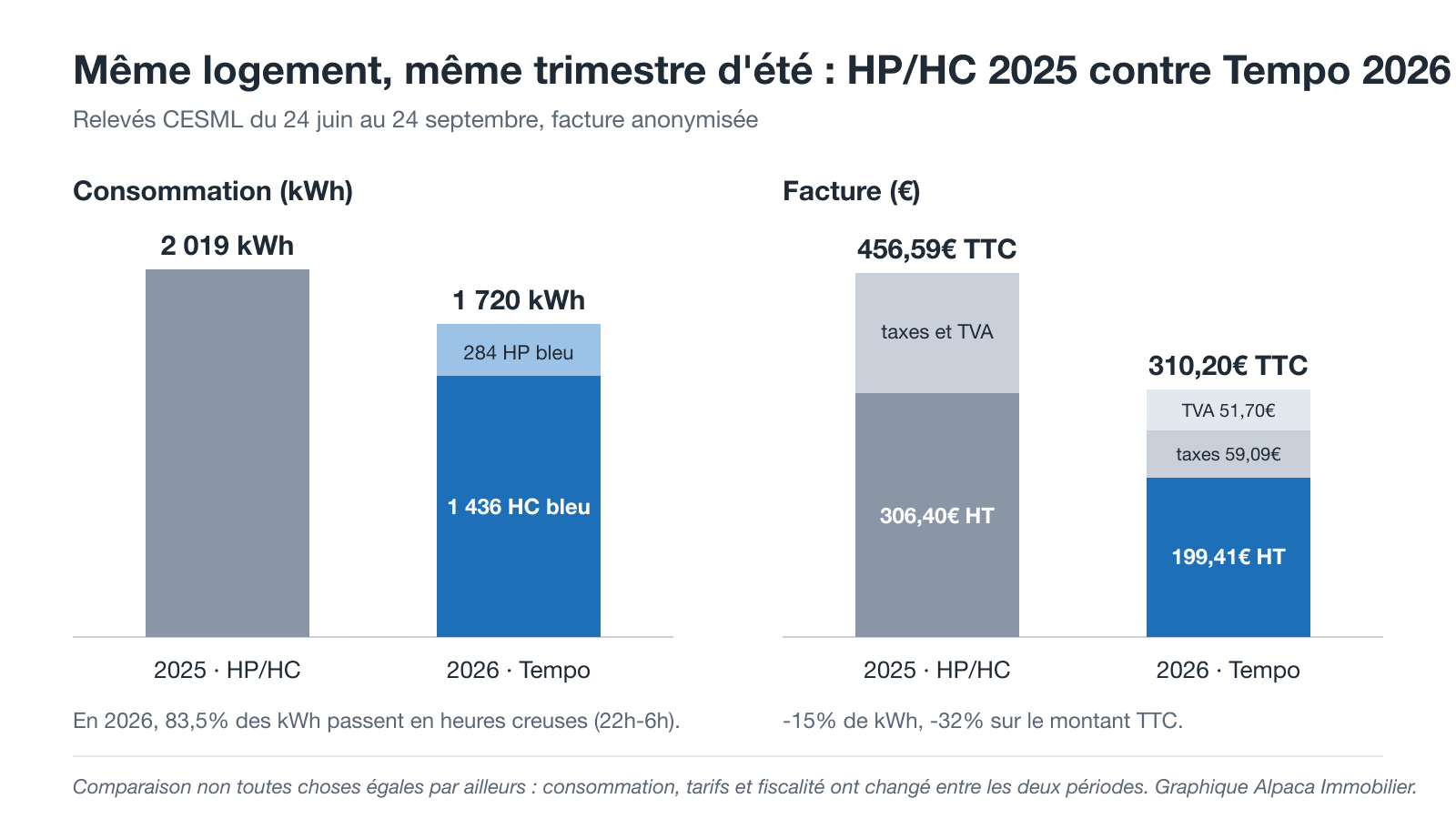
| Summer quarter | 2025, HP/HC option | 2026, Tempo option |
|---|---|---|
| Consumption | 2,019 kWh | 1,720 kWh |
| Of which off-peak | - | 1,436 kWh (83.5%) |
| Amount before tax | €306.40 | €199.41 |
| Amount including tax | €456.59 | €310.20 |
Consumption fell by 15%, the amount including tax by 32%. In 2026, 83.5% of kWh fell in off-peak hours on blue days, billed at just over €0.08 per kWh before tax.
Bear in mind that this is not a like-for-like comparison. Between the two summers, consumption changed, the regulated tariff moved and so did taxation: VAT on the standing charge rose to 20% on 1 August 2025, right in the middle of the 2025 quarter, and both the CTA and the excise duty were changed in 2026. A summer quarter also contains no red days. This case shows what Tempo can deliver when usage is concentrated at night; it does not predict the annual saving for another home.
Who Tempo suits, and who it does not
Tempo is worthwhile if a large share of your consumption can move to the night or be cut back on red days, for example with:
- a water heater, washing machine and dishwasher programmed to run after 10 pm;
- an electric vehicle charged overnight, with a home charging point or a charging point in a shared building;
- controllable heating, for example with a smart thermostat, or a wood-burning backup heater;
- solar panels for self-consumption, which cover part of the daytime peak hours.
It becomes risky in a home heated by electricity with no way of controlling it and occupied during the day in winter, or for a tenant who does not want to keep an eye on the next day's colour. Twenty-two poorly anticipated red days can wipe out much of the saving made over the rest of the year.
Enedis's new off-peak hours
Since November 2025 and until the end of 2027, Enedis has been gradually changing off-peak time slots: from 1 April to 31 October, two to three off-peak hours are placed between 11 am and 5 pm, to take advantage of solar production. The Tempo option is not affected by this reform. For areas served by an ELD such as the CESML, we found no source confirming that it applies. If the question concerns you, the simplest course is to ask the CESML directly.
Compare before you switch: the method
- Find your annual consumption in kWh, with the HP/HC split if you have it. It appears on your bill or in your online customer account.
- Check your subscribed power. If your meter never trips, a lower power level might reduce the standing charge.
- Use the official comparison tool comparateur-offres.energie-info.fr, published by the National Energy Ombudsman (Médiateur national de l'énergie), an independent public authority. It is free, independent of suppliers and shows the offers available at your address, which matters a great deal in the CESML area.
- Compare amounts including tax over a year, standing charge included, and look at how long the price is guaranteed.
- Only change option once you know your usage. Switching to Tempo without being able to shift your heating amounts to betting on the winter.
EDF referral scheme: worth checking once you have chosen an offer
Once you have chosen your offer, it is worth checking whether the supplier runs a referral scheme. The Le Parrain website keeps a list of referral programmes in the energy sector, which lets you quickly see whether your supplier has one.
EDF's official referral programme provides, until 31 December 2026, €40 including tax for the referred customer and €20 including tax for the referrer (up to five referrals per referrer). It applies only to EDF's market offers, excluding the Zen Online offer, for a new subscription in mainland France, excluding Corsica. The full terms are on EDF's referral page.
Alpaca Immobilier referral
- Referrer: Antoine Kara Invest
- Referrer's email: antoine@kara-invest.com
- EDF customer number: 6 021 477 681
Subscription by phone only, on 3404 (Monday to Saturday, 8 am to 8 pm). Give this referral information at the very start of the call, before the adviser registers your contract.
If you live in the CESML area, bear in mind that the EDF scheme covers only its market offers. Signing up means leaving the CESML's regulated tariff for an EDF market offer. Compare the two on the official comparison tool before calling, and check that the offer is actually available at your address.
Frequently asked questions
Can you go back to the regulated tariff after a market offer?
Yes. A private customer can return to the regulated tariff at any time, at no cost, with the incumbent supplier for their area: EDF in most municipalities, the CESML in its own.
Does the landlord choose the tenant's electricity supplier?
No. The tenant who holds the contract is free to choose their supplier and option. The landlord can, however, give them the useful information when they move in: delivery point number, power level, distributor.
Is Tempo available in the CESML area?
Yes. The CESML offers the Tempo option of the tarif Bleu, with the same calendar of blue, white and red days.
In short
| Question | Short answer |
|---|---|
| Why is the amount including tax more than 20% above the pre-tax amount? | The excise duty and the CTA are added before VAT, which also applies to those taxes. |
| Who sells the regulated tariff? | EDF, except in ELD areas: around Montpellier, the CESML in its municipalities. |
| Is Tempo always cheaper? | No. It pays off if you shift your usage to the night and limit consumption on red days. |
| Where can you compare offers? | On the National Energy Ombudsman's comparison tool, free and independent. |
| Does the EDF referral scheme apply to the regulated tariff? | No, it covers only EDF's market offers. |
Own a home to let around Montpellier? Our teams handle every tenant move-in, meter readings included. The details are on our property management page.
Sources
Information checked on 2 October 2026. Tariffs, excise duty, the Tempo calendar and the terms of the referral programme change over time: check them again before making any decision.
- National Energy Ombudsman, energie-info.fr: taxes on the electricity bill and offer comparison tool
- Energy Regulatory Commission, decisions on regulated electricity tariffs (2026)
- CESML, overview and municipalities served and Tempo tariffs
- EDF, referral programme and programme terms
Header photo: Mikhail Nilov, via Pexels.