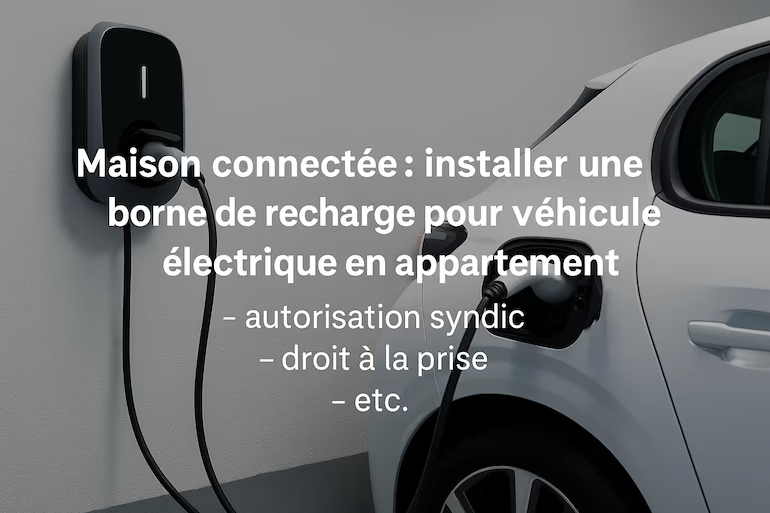
We already wrote an article for you presenting the benefits of a charging station for electric vehicles in a house. But what about when you live in an apartment?
Electric mobility is now establishing itself as a new pillar of this transition. Installing a charging station for an electric vehicle is no longer reserved for single-family homes: it is now entirely possible in a condominium, thanks to the right to a plug.
The legal framework: a right recognized for all occupants
Since decree n° 2011-873 of July 25, 2011, then reinforced by law n° 2018-1021 known as "ELAN", any condominium owner, tenant, or occupant in good faith has the right to a plug.
This right is provided for in article L111-6-4 of the Code of Construction and Housing (CCH), which states that:
"Any occupant of a multi-unit building primarily used for residential purposes may, at their own expense, equip a parking space with a charging device for an electric or rechargeable hybrid vehicle."
In practice, it is not necessary to obtain a vote at a general assembly to exercise this right. You only need to notify the condominium manager by registered letter with acknowledgment of receipt, attaching:
-
a technical installation plan,
-
a quote from an IRVE-certified company (Electric Vehicle Charging Infrastructure),
-
and a description of the device (electrical connection, protections, power, etc.).
The condominium manager then has 3 months to object, only for serious reasons:
-
technical impossibility,
-
risk to the safety of the building,
-
or the existence of collective infrastructure already planned or voted on (article R111-14-2 of the CCH).
After this period, the applicant may proceed with the installation, subject to electrical compliance and compliance with current standards.
2. Technical solutions in a condominium
Installing a charging station in a multi-unit building can be done in several ways:
a) Connection to the individual meter
This is the simplest solution when the parking space is close to the home or private electrical panel.
👉 Advantages: consumption directly recorded on the personal bill, complete autonomy.
👉 Disadvantages: limited feasibility if the parking is far from the panel or if no technical conduit is available.
b) Connection to common areas with sub-meter
A charging station can be connected to the common areas meter, with a dedicated sub-meter to bill the consumption to the resident in question.
This configuration requires the condominium manager's approval, as it impacts condominium charges.
c) Collective infrastructure or "pre-equipment"
Since the decree of July 13, 2016, new buildings must provide pre-installation of conduits to facilitate future installation of charging stations.
Some condominiums today choose to install a collective charging system managed by a third-party operator (such as Zeplug, Bump, or Park'nPlug). This provider handles the connection, power management, billing, and maintenance, which greatly simplifies residents' lives.
3. Standards and power ratings to know
Charging stations must comply with standards NF C 15-100 and NF EN 61851-1.
They are generally of three types:
-
Reinforced plug (3.2 kW): for small vehicles or occasional charging.
-
Wall-mounted station (7.4 to 11 kW): the most common, allows full charging in 6 to 8 hours.
-
Three-phase station (22 kW): for vehicles with large batteries or professional use.
It is essential that the installation be carried out by an IRVE-certified electrician, in accordance with the decree of January 12, 2017.
4. Available financial assistance
The ADVENIR program, supported by the State and ADEME, finances up to 50% of the installation cost (capped at 960€ including tax for an individual in a condominium).
Some local authorities (such as Montpellier Méditerranée Métropole) may also grant additional subsidies.
Furthermore, the equipment is eligible for the reduced VAT rate of 5.5% and tax credit for energy transition (CITE), according to current conditions.
5. Best practices and advice
-
Anticipate the electrical power required: a 7.4 kW charging station requires a 40 A circuit breaker and a 6 mm² cable minimum.
-
Favor smart charging (managed), allowing optimization of consumption according to off-peak hours.
-
Inform your home insurance: they must be aware of any fixed electrical installation in common areas.
-
In case of resale of the property, keep the IRVE declaration and invoices: they are a real real estate asset!
In summary
Installing a charging station in a multi-unit building is now a right guaranteed by law. With financial aid schemes, the generalization of collective solutions, and the increasing power of electric vehicles, it is becoming increasingly simple to integrate sustainable mobility into your smart home.