
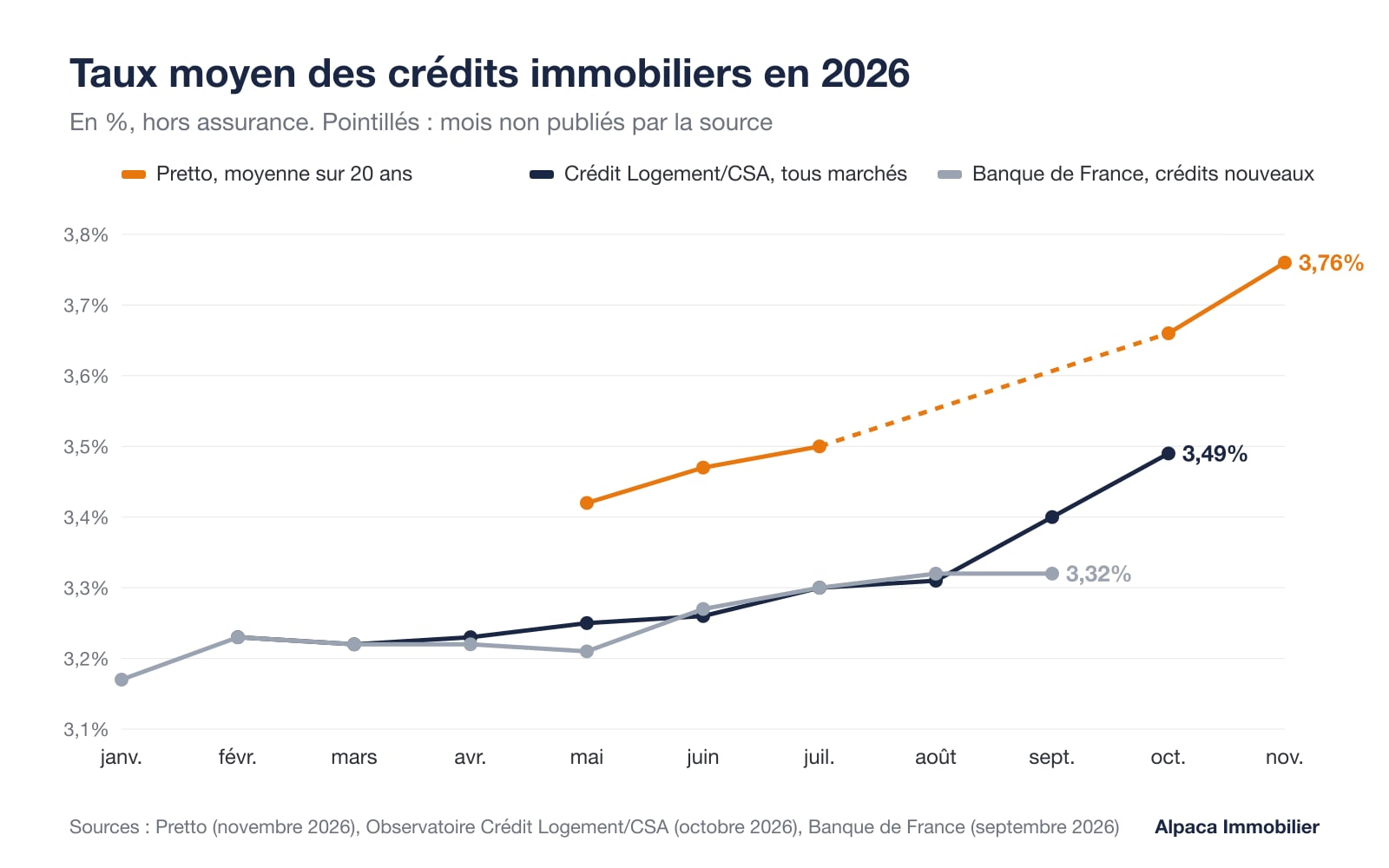
In November 2026, the mortgage broker Pretto records an average rate of 3.76% over 20 years and 3.85% over 25 years, excluding insurance, around 0.10 percentage point more than in October (Pretto, November 2026 analysis). Yet the European Central Bank left its rates unchanged on 29 October: the rise comes from the cost at which banks fund themselves, pushed up by French public debt and by energy inflation. In our worked example, a couple earning €4,500 net a month has lost around €10,600 of borrowing capacity over 25 years since May.
The 4% threshold is crossed, on average, for households earning less than €40,000 a year and borrowing over 25 years. We cross-checked Pretto's figures against those of the Observatoire Crédit Logement/CSA, the Banque de France and a second broker, then applied the whole to a purchase in the north of Montpellier (sources checked on 26 November 2026).
November 2026 rates, source by source
Pretto: 3.76% over 20 years, 4.07% for lower incomes
Each month, Pretto publishes average rates "for all profiles", calculated from the offers obtained by its clients. For November 2026, it gives 3.56% over 15 years, 3.76% over 20 years and 3.85% over 25 years, against 3.50%, 3.66% and 3.75% in October (Pretto, November 2026). The trend was already visible at the end of August, in our article on September 2026 mortgage rates in Montpellier: Eloa's barometer then showed 3.35% across all loan terms, and brokers expected rates to head upwards towards the end of the year.
Rates vary markedly with income. Pretto breaks them down by the household's annual net income bracket:
| Term | Under €40,000 | €40,000 to €80,000 | €80,000 to €120,000 | Over €120,000 |
|---|---|---|---|---|
| 20 years | 3.91% | 3.85% | 3.80% | 3.47% |
| 25 years | 4.07% | 3.97% | 3.82% | 3.53% |
Only the first bracket therefore exceeds 4% on average, and only over 25 years. Pretto also notes regional rate grids above 4% before negotiation, for example 4.05% in Hauts-de-France, and an extra cost of around a tenth of a point for first-time buyers. At the other end, the strongest applications obtain between 3.35% and 3.45% over 25 years depending on the region.
Other measures confirm the direction, at lower levels
Each barometer has its own method, hence the different levels, but all of them are rising:
- The Observatoire Crédit Logement/CSA, run by a company that guarantees home loans, tracks loans actually granted. In October 2026, the latest month published, the average rate reaches 3.49%, against 3.40% in September, for an average term of 253 months. On fixed-rate loans, it stands at 3.32% over 15 years, 3.54% over 20 years and 3.57% over 25 years (Crédit Logement/CSA, October 2026).
- At the Banque de France, the average rate on new home loans, excluding renegotiations, remains at 3.32% in September 2026, as in August, against 3.09% a year earlier (Banque de France, publication of 5 November 2026). This statistic lags by two months and covers loans signed on the basis of older offers.
- Meilleurtaux puts its average negotiated rates for November at around 3.50% over 15 years, 3.70% over 20 years and 3.80% over 25 years, and states that banks' rate grids generally exceed 4% before negotiation (Meilleurtaux, updated on 2 November 2026).
Brokers are thus one to two months ahead of Crédit Logement and the Banque de France, which record loans already granted.
The usury rate stays at 5.40%
The taux d'usure (usury rate) is the legal ceiling on the TAEG (the annual percentage rate of charge, which adds up interest, insurance and fees). From 1 October to 31 December 2026, it stands at 5.40% for fixed-rate loans of 20 years or more, 4.68% between 10 and 20 years and 4.09% under 10 years (Banque de France, usury rates for Q4 2026). The same page gives an average effective rate of 4.05% in the third quarter for loans of 20 years or more, insurance included. There is therefore still some headroom, but Meilleurtaux observes that the ceiling is starting to block small projects, on which insurance and fees weigh proportionally more.
Why rates are rising while the ECB holds still
The ECB pauses after two increases
The ECB Governing Council left its three key interest rates unchanged at its meeting of 29 October 2026. The deposit facility rate, which remunerates the liquidity banks place with the ECB, stays at 2.50% (ECB, press release of 29 October 2026). This level results from the 25 basis point increase decided on 10 September and applied since 16 September, on the grounds that "the conflict in the Middle East continues to generate inflationary pressures" (our translation of the French version, ECB, press release of 10 September 2026). Pretto points out that a first increase had taken place in June.
The ECB does not promise a cut for all that. Its October press release notes that energy prices "have continued to rise, posing upside risks to the inflation outlook" and that it will decide "meeting by meeting". According to Trading Economics, markets expect at least two further increases (Trading Economics, 20 November 2026). A bank lending over 20 or 25 years takes these expectations into account, and not only today's rate. The next monetary policy meeting is scheduled for 16 and 17 December 2026 (ECB, calendar).
The 10-year OAT touched 5%
The 10-year OAT is the rate at which the French State borrows over ten years, and banks refer to it when pricing their long-term funding. On 21 October 2026, it crossed 5%, a level unseen since 2002, against a backdrop of doubts over the budget, social tensions and uncertainty ahead of the presidential election; the day before, the spread with the German rate had reached 153 basis points (Tradingsat, 21 October 2026). It has eased since, to around 4.74% on 26 November, but remains well above its level at the start of the year (Trading Economics, 26 November 2026).
Meilleurtaux describes a situation that is hard to sustain: with the OAT close to 5%, banks lend over 20 years at an average rate below what it costs the State to borrow over the same term. Hence rate grid increases in the middle of the month, of which Pretto cites several examples in mid-October: +0.25 point at Crédit Mutuel du Sud-Ouest from 19 October, +0.20 point at Crédit Agricole Île-de-France on 21 October.
Banks that drive a harder bargain
Banks are also granting fewer discounts. Meilleurtaux estimates the real increase at around 25 points in one month: about twenty points on the rate grids, plus discounts that are harder to obtain. Before granting a reduction, banks ask for more arguments (deposit, savings left after the purchase, stable income). Crédit Logement, for its part, attributes the rise to "the return of inflationary pressures and the rise in the ECB's key rates" (our translation).
Simulation: what the rise takes off your borrowing capacity
The formula and the assumptions
The monthly payment on a fixed-rate repayment loan is calculated as follows:
M = C × i / (1 − (1 + i)^(−n))
where C is the capital borrowed, i the annual rate divided by 12 and n the number of monthly payments (240 for 20 years, 300 for 25 years). To obtain the borrowing capacity, we invert the formula starting from the maximum monthly payment.
The standard set by the Haut Conseil de stabilité financière (HCSF, the French financial stability council) sets "a maximum debt-to-income ratio for borrowers of 35%" and "a maximum loan maturity of 25 years", with banks allowed to depart from it for 20% of their lending (our translation, ministerial answer published on 28 April 2026). The debt-to-income ratio compares all monthly loan repayments with income.
The assumptions are our own and do not describe any real application:
- a couple with a net income of €4,500 a month, i.e. €54,000 a year, with no other loan outstanding;
- a maximum monthly payment of €1,575 (35% of €4,500), insurance included, as a precaution;
- borrower insurance at 0.25% a year of the initial capital, an assumption for the example;
- Pretto's average "all profiles" rates for May 2026 (Pretto, May 2026) and November 2026, then the rate for the €40,000 to €80,000 income bracket, which is our couple's.
The results
| Rate used | Term | Borrowable capital | Monthly payment excl. insurance | Monthly insurance | Interest over the term |
|---|---|---|---|---|---|
| 3.42% (May 2026 average) | 20 years | €264,000 | €1,520 | €55 | €100,800 |
| 3.76% (November 2026 average) | 20 years | €256,400 | €1,522 | €53 | €108,800 |
| 3.85% (€40-80k bracket, November) | 20 years | €254,500 | €1,522 | €53 | €110,800 |
| 3.50% (May 2026 average) | 25 years | €302,000 | €1,512 | €63 | €151,600 |
| 3.85% (November 2026 average) | 25 years | €291,400 | €1,514 | €61 | €162,800 |
| 3.97% (€40-80k bracket, November) | 25 years | €287,900 | €1,515 | €60 | €166,600 |
Amounts rounded to the nearest hundred euros, monthly payments to the nearest euro.
For the same monthly payment, the rise from May to November takes around €7,500 off borrowing capacity over 20 years and €10,600 over 25 years. At the rate for its income bracket, our couple loses €14,100 over 25 years compared with the May average. In this example, each additional tenth of a point over 25 years costs around €2,900 of capital.
For a fixed capital, for example €250,000 over 25 years, the monthly payment excluding insurance goes from €1,252 at 3.50% to €1,299 at 3.85%: €47 more a month and around €14,200 of additional interest over the life of the loan.
At 3.97% over 25 years, the nominal rate and insurance add up to around 4.2% in our example, before guarantee and arrangement fees. The TAEG stays below the 5.40% ceiling, but the gap narrows with more expensive insurance, that of an older borrower or of a small loan amount for example.
Applied to a purchase in the north of Montpellier
Let us return to the couple in the example, with a hypothetical deposit of €30,000. For an existing property, the purchase costs (transfer duties, notary's fees and disbursements) represent "between 7% and 8% of the purchase price" according to a notarial study (our translation, Fourez Notaires). We use 8% as a precaution and leave aside the loan guarantee fees.
- At the average May 2026 rates over 25 years, the total budget (€302,000 borrowed and a €30,000 deposit) allows a purchase price of around €307,400.
- At November rates, the same couple can aim for around €297,600.
- At the rate for its income bracket, 3.97%, it falls to around €294,400.
In six months, the affordable price has therefore dropped by €10,000 to €13,000, with income unchanged. In Saint-Clément-de-Rivière, Saint-Gély-du-Fesc or Prades-le-Lez, that can decide between two properties on the same street or cost a room. Our property prices in Montpellier and the north of the metropolitan area, presented area by area, show what this budget buys in each commune.
For sellers, the effect is immediate: a buyer financing the purchase with a loan loses a few thousand euros of budget with every tenth of a point. A price set on the basis of spring financing conditions risks exceeding what winter buyers can pay. A valuation based on recent sales lets you check this before putting the property on the market.
What to do depending on your situation
You are preparing a purchase: your deposit and remaining savings count in the negotiation
The rate gap between income brackets shows that banks are sorting applications. According to Meilleurtaux, they reserve their discounts for borrowers who put in their own funds, keep savings available after the purchase and have stable income. A deposit that covers at least the purchase costs remains the basis of any negotiation. Our article on borrower profiles and buying power in Montpellier in 2026 gives the average deposits observed at the start of the year.
You are unsure about the term: 25 years increases both the budget and the total cost
In our example, going from 20 to 25 years adds around €35,000 of borrowing capacity at November rates, but adds around €54,000 of interest. Except in specific cases, 25 years is the maximum allowed by the HCSF standard, and almost one loan in two is now granted over that term or longer (49.3% in October, according to Crédit Logement). A longer term should not lead you to buy above what the household budget can bear once day-to-day expenses are paid.
You are borrowing: shop around for insurance
Borrower insurance does not depend on the lending bank. Since the loi Lemoine (the French law on borrower insurance), you can switch at any time after the loan is signed, provided the new contract offers an equivalent level of cover; the bank must respond and, if it accepts, amend the loan agreement within ten working days (Service Public, checked on 20 May 2025). No health questionnaire can be required if the loan is €200,000 or less per insured person and is to be repaid before the age of 60. For a young borrower, choosing an external insurer can cut this cost significantly and leave more of the monthly payment for the capital.
You already have a loan: renegotiation only concerns higher rates
Average rates have been rising since the spring. Renegotiating is therefore only worthwhile for a loan signed at a rate well above current conditions, once early repayment penalties and the cost of a new guarantee are deducted. For most recent loans, insurance remains the most accessible lever.
You are a first-time buyer: check the PTZ
The prêt à taux zéro (PTZ, an interest-free loan) finances part of a first-time buyer's purchase without interest, subject to income conditions, under the rules applicable to offers issued since April 2025 (Service Public, checked on 15 September 2026). The higher rates go, the more this interest-free portion lightens the total cost. Zones, ceilings and proportions are detailed in our article on the PTZ in 2026: eligibility and ceilings.
What could still change before January
- In force: the 5.40% usury rate for loans of 20 years or more, until 31 December 2026, and the ECB deposit rate at 2.50%.
- Known calendar: the ECB meets on 16 and 17 December 2026. Pretto also flags a review of France's rating by S&P expected on 27 November, after Moody's kept a negative outlook on 23 October.
- Projected: markets expect further ECB increases. Nothing guarantees they will happen, and we do not make rate forecasts.
Waiting for rates to ease before signing remains a gamble, when every tenth of a point is paid for in borrowing capacity. With a complete application, on the other hand, you can accept an offer as soon as it arrives.
Frequently asked questions
What is the average mortgage rate in November 2026?
According to Pretto, 3.56% over 15 years, 3.76% over 20 years and 3.85% over 25 years, excluding insurance. Meilleurtaux's negotiated rates are close, at around 3.70% over 20 years and 3.80% over 25 years. The Observatoire Crédit Logement/CSA, which measures loans granted, gave an average of 3.49% in October.
Are mortgage rates above 4%?
On average, only for certain profiles: 4.07% over 25 years for households earning less than €40,000 a year, according to Pretto. Some bank rate grids also exceed 4% before negotiation.
Why are rates rising if the ECB did not raise its rates in October?
Banks refinance themselves on markets where the 10-year OAT reached 5% on 21 October, and these markets expect further increases from the ECB, which already raised its rates in June and in September. Banks are also granting fewer discounts on their rate grids.
How much can I borrow with an income of €4,500 in November 2026?
In our example, with a monthly payment of €1,575 including insurance (35% of income) and no other loan, around €256,400 over 20 years and €291,400 over 25 years at average November rates. Your actual capacity depends on your application, your rate and your insurance.
If your purchase project concerns Montpellier or the north of the metropolitan area, we can help you target properties that fit your budget (see our page buying with Alpaca Immobilier).
Sources
- ECB, monetary policy decisions of 29 October 2026
- ECB, monetary policy decisions of 10 September 2026
- ECB, calendar of Governing Council meetings
- Banque de France, loans to individuals, September 2026
- Banque de France, usury rates for Q4 2026
- Observatoire Crédit Logement/CSA, October 2026
- Pretto, analysis of November 2026 rates
- Meilleurtaux, analysis of November 2026 rates
- Assemblée nationale, written question No. 11983, answer of 28 April 2026 (HCSF standard)
- Service Public, borrower insurance for a mortgage