
You have found the ideal buyer, the price is agreed and the notary has the preliminary contract in hand. Then a letter arrives from the town hall: the municipality is pre-empting. The buyer you chose is pushed aside, your sale is delayed by three months, and sometimes it does not go through at all. This scenario is far from exceptional. At Alpaca Immobilier we see it regularly, and it is almost always the same story: nobody had anticipated the pre-emption risk.
Pre-emption is the blind spot of many transactions. The price, the condition of the property and the buyer's financing get all the attention, and the pre-emption risk slips through the cracks. Yet a third party - a town hall, a tenant, the SAFER - may hold a priority right over your sale. Let us go through the subject, without needless jargon, with realistic orders of magnitude and a few cases that went wrong.
What exactly is pre-emption?
The pre-emption right (droit de préemption) is the power the law gives a specific person to step into the shoes of the buyer you chose, at the same price and on the same terms. You remain free to sell or not, and to set your price. But you are no longer entirely free to choose who you sell to.
In practice, the mechanism is always the same: before the sale, the property is "notified" to the holder of the pre-emption right (often by the notary). The holder has a set period - usually 2 months - to say whether it wishes to buy. If it exercises the option, it takes your buyer's place. If it says nothing, its silence counts as a waiver and the sale goes ahead.
Pre-emption must be clearly distinguished from compulsory purchase (expropriation). Compulsory purchase forces you to sell for a public-interest project. Pre-emption only comes into play if you have decided to sell of your own free will. As long as you can withdraw from the sale if you disagree on the price, you keep control of what matters.
The landscape: who can pre-empt your property?
There is not one pre-emption right but a whole family of them. Here are the main ones, those we come across most often in the field.
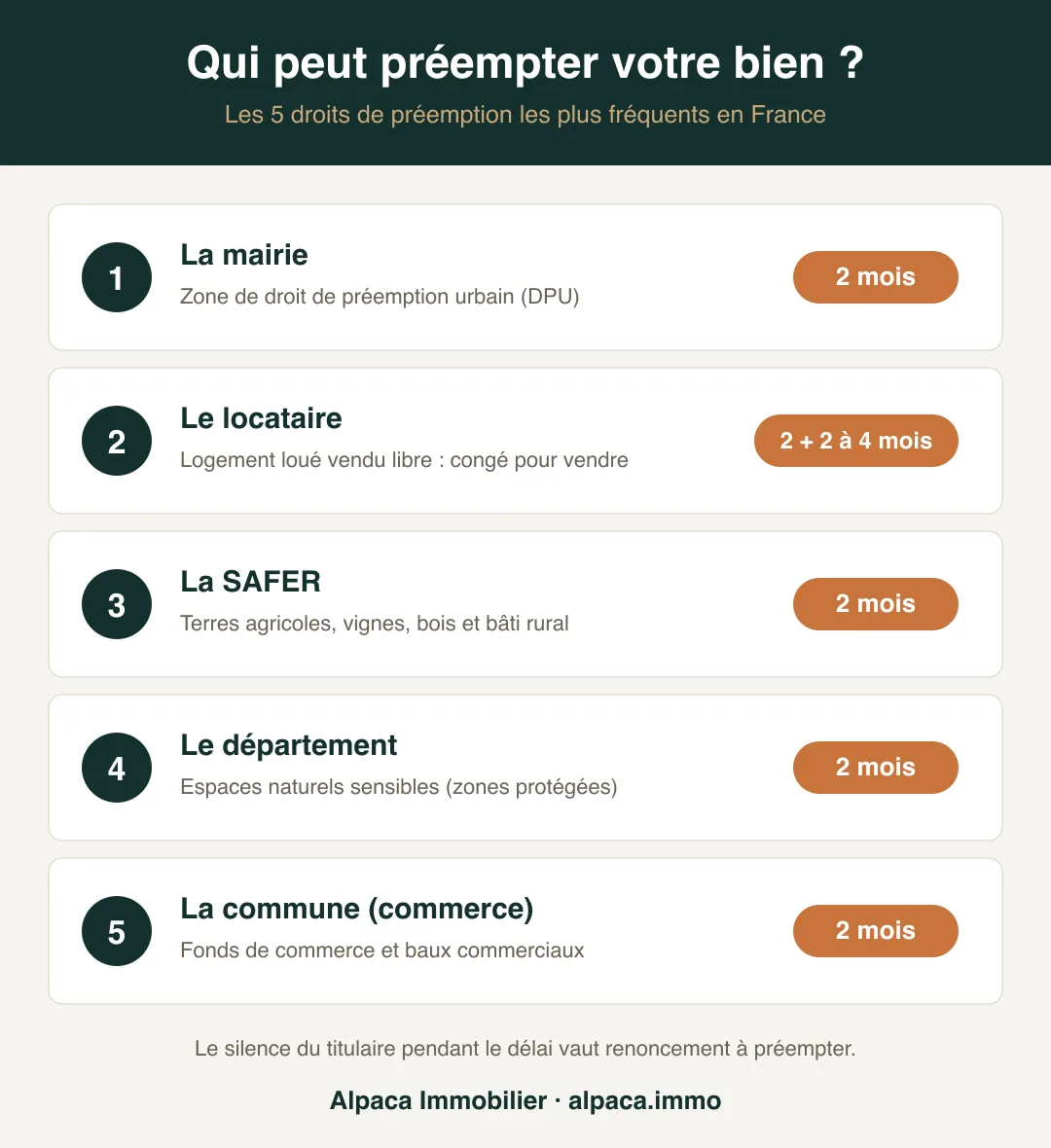 The five holders who can pre-empt a property and the deadline each one has.
The town hall: the urban pre-emption right (DPU)
This is the most common. In the urban and future development zones of their local development plan (plan local d'urbanisme, PLU), municipalities can institute an urban pre-emption right (droit de préemption urbain, DPU) (articles L211-1 et seq. of the French Town Planning Code). As soon as a sale is agreed, the notary sends the town hall a declaration of intent to sell (déclaration d'intention d'aliéner), the well-known DIA. The municipality then has 2 months to respond.
There are three scenarios. It does not reply: all the better, you sell as normal. It pre-empts at the agreed price: your buyer is ousted and the municipality buys. It pre-empts at a lower price: you can accept, withdraw from the sale or refer the matter to the expropriation judge (juge de l'expropriation) to set the price. You are never obliged to sell off cheaply.
Worth knowing: a purely financial pre-emption decision, taken to make a capital gain or to keep out an "undesirable" buyer, can be challenged before the administrative court within 2 months. The town hall must demonstrate a genuine public-interest project (social housing, public facilities, development). If the justification is spurious, the decision can be annulled.
The sitting tenant: the trickiest right
This is by far the one that demands the greatest vigilance from us. When you sell a home let unfurnished and want to deliver it vacant, you must serve your tenant a notice to quit for sale (congé pour vendre), at least 6 months before the end of the lease (article 15, II of the law of 6 July 1989). This notice counts as an offer to sell: your tenant has priority to buy, at the price and on the terms you propose.
The tenant has 2 months to accept. If they accept and take out a loan, the signing deadline extends to 4 months. Beyond that, their silence counts as a waiver and you are free to sell to a third party - but be careful, not at a lower price without first presenting the new offer to the tenant.
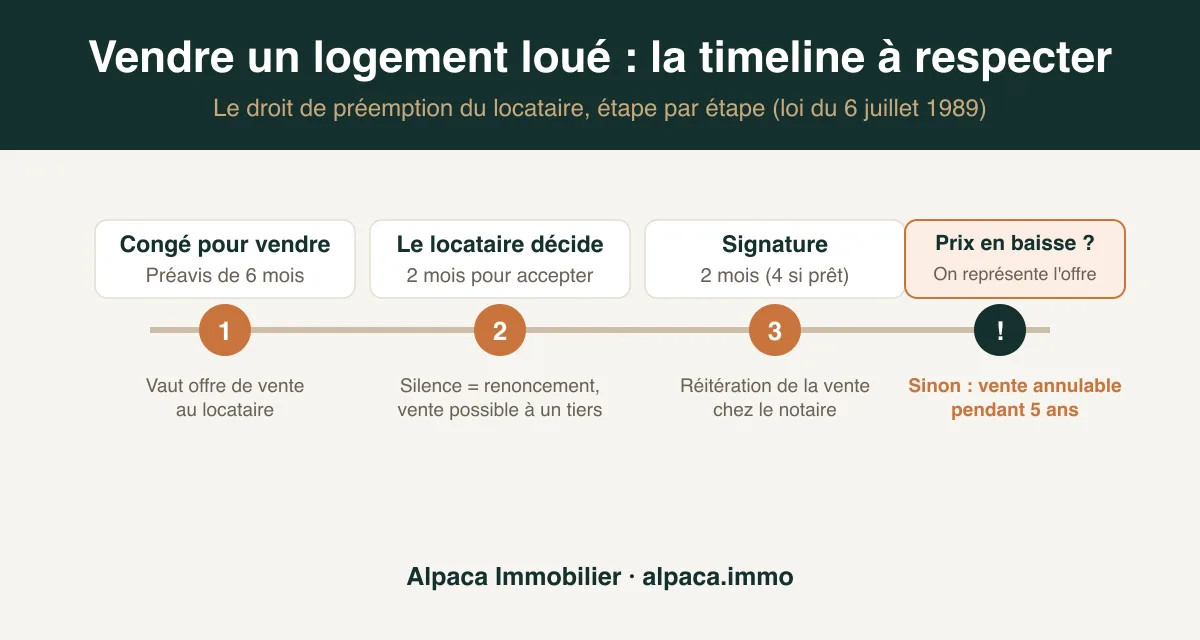 Notice, acceptance period, signing: every step counts, and the slightest error can cost you the sale.
Why is it the number one risk? Because this right is a matter of public policy, its sanction is severe and sellers (sometimes poorly advised) overlook it. We come back to it in detail below.
Selling a flat or house that is still occupied? This is exactly the situation where a procedural error can derail everything. Request a free valuation of your property: we check the pre-emption risks before the property even goes on the market.
The SAFER: farmland, and more
If your property includes agricultural land, farm buildings, plots with a rural purpose or even woodland, the SAFER (the regional land development agency, société d'aménagement foncier et d'établissement rural) can pre-empt (articles L143-1 et seq. of the French Rural Code). Here again: notification, a 2-month period, and the option for the SAFER to revise the price downwards - it is up to you to accept, withdraw or go to court.
The classic trap: a private sale of a plot with a scrap of meadow or vineyard, signed without a notary and without informing the SAFER. The sale can be cancelled several months later and the SAFER declared the buyer in your place. As soon as the lot includes rural land, it is better to notify.
The department: sensitive natural areas
In certain perimeters defined by the departmental council - wetlands, wooded areas, riverbanks, coastline - the department holds a pre-emption right over sensitive natural areas (espaces naturels sensibles) (articles L215-1 et seq. of the French Town Planning Code). Same logic: notification, 2 months, pre-emption at the price or at a negotiated price. It is not the most frequent in town, but if your property borders a protected natural area, it must be checked.
Commercial pre-emption
Within "local retail protection perimeters" (périmètres de sauvegarde du commerce de proximité), a municipality can pre-empt the transfer of a business (fonds de commerce) or a commercial lease (articles L214-1 et seq. of the French Town Planning Code). The aim: to stop a neighbourhood losing its shops or turning into a row of identical chain stores. The period is 2 months, after which the municipality must sell on to another trader. If you are selling or buying commercial premises, this is a point we build into our support for retail premises and businesses.
When the tenant's right is not respected: the sale can collapse
This is where things get serious, and it is why we insist on it so much with our sellers.
The sanction for breaching the tenant's pre-emption right is the nullity of the sale concluded with the third party. Not a fine, not mere compensation: the sale is cancelled. And the French Court of Cassation (Cour de cassation) has been consistent on this point for a long time.
A few concrete reference points, taken from real decisions:
- Cass. 3e civ., 15 November 2006, no. 04-16.664: the Supreme Court holds that the sanction for breaching the tenant's pre-emption right is the nullity of the sale made to the third party.
- Cass. 3e civ., 12 April 2018, no. 17-11.015 then Cass. 3e civ., 11 October 2018, no. 16-26.748: the Court confirms and hammers home the principle - breach of the pre-emption right leads only to the nullity of the sale, with no right for the tenant to take the buyer's place.
This last point is important and often misunderstood. The wronged tenant can have the sale cancelled, but cannot be declared the buyer in place of the third party. Nullity resets everything: the property returns to the seller's estate, and the seller will have to start the procedure again properly. For the ousted buyer, it means lost time, costs, and sometimes a mortgage arranged for nothing.
And the time limit for taking action is not short: the tenant has 5 years to seek nullity (article 2224 of the French Civil Code), from the day they became aware of the irregular sale. In other words, a botched sale can come back to haunt you two or three years later, when the buyer has already carried out works and everyone thought the matter was settled.
The cases that go wrong are almost always the same. A landlord who sells an occupied flat without serving notice to quit for sale. An owner who offers the property to their tenant at €250,000, is turned down, then quietly sells it to an investor at €235,000 without presenting this new offer: the price cut reopens the pre-emption right and the sale can be challenged. Each time, the urge to "move fast" costs far more than the correct procedure.
A word on selling entire buildings: the tenant's pre-emption right does not apply to an "en bloc" sale of the whole building (Cass. 3e civ., 11 March 2015, no. 14-10.447). It is a genuine exception, but it is strictly framed. Do not imagine you can get around the tenant's right by dressing up an individual sale as an overall sale: the judges look at the reality of the transaction, not its label.
Rarer (but very real) pre-emption rights
Alongside the major classics, there are lesser-known rights that can still block a sale.
The commercial tenant (Pinel law). Since 2014, when you sell occupied commercial premises, the tenant enjoys a right of first refusal (droit de préférence) (article L145-46-1 of the French Commercial Code). They have 1 month to accept the offer, then 2 months to sign - 4 months if they borrow. The Court of Cassation scrutinises the content of the offer: it has ruled, for example, that the landlord cannot make the tenant pay the agency fee by inflating the price (Cass. 3e civ., 28 June 2018, no. 17-14.605). In 2025 it also clarified the exceptions, notably the overall sale of a building containing a single commercial unit, which falls outside this right of first refusal.
Small forest plots. Here is a pre-emption right few people know about. Since the 2014 agricultural future law (loi d'avenir agricole), the sale of a wooded plot of less than 4 hectares must be notified to the neighbouring forest owners, who hold a right of first refusal (articles L331-19 et seq. of the French Forestry Code). The ousted neighbour can have the sale cancelled and be substituted for the buyer. If you are selling a patch of woodland in the countryside, this is no minor detail.
The Conservatoire du littoral (the coastal protection agency) can intervene on bare or lightly built land in coastal areas, under delegated pre-emption rights. The State, finally, has prerogatives over certain cultural assets and in remarkable heritage sites (sites patrimoniaux remarquables), but for ordinary property the impact is felt mainly in planning permission for works, not in pre-emption as such.
Our practical advice to avoid being caught out
After dozens of transactions, here is what we systematically recommend, to sellers and buyers alike.
Identify the risk before you even put the property on the market. Is the property let? In a DPU zone? Is there farmland, woodland or a natural area nearby? A planning certificate (certificat d'urbanisme) and a reading of the PLU answer the essentials. Five minutes of checking upfront is better than three months of deadlock.
If the property is let, never take liberties with the notice to quit for sale. It is the costliest risk item. Respect the 6-month notice period, the offer at the right price and the acceptance deadlines. Above all, if you end up selling for less than the price offered to the tenant, present the offer to them again. This forgotten re-offer is what brings down the most sales. Our sales support exists precisely to secure these steps.
Use a notary and an agent who plan ahead. The DIA, the SAFER notification, the calculation of deadlines: all of this is handled upfront. A good professional builds the pre-emption risk into the preliminary contract from the outset, with a suitable condition, so that nobody ends up stuck.
As a buyer, read the pre-emption clause in your preliminary sale agreement (compromis). It generally provides that the preliminary contract lapses if a right holder pre-empts, with no compensation for you beyond costs. Know this before you start planning, let alone committing to brokerage or renovation costs. If you are looking to buy a property around Montpellier, we flag these points from the first viewing.
Factor in the time. A DIA means 2 months. A notice to quit for sale means 6 months' notice plus the acceptance periods. These weeks count in a sale timetable, especially if you are moving straight on to another purchase. Better to include them from the start than to discover them when it is time to sign.
In summary
Pre-emption is not inevitable; it is a risk that can be managed. In the vast majority of cases, a town hall does not pre-empt, a SAFER lets the sale through and a tenant declines. But the day one of them exercises their right, or worse, the day a poorly handled procedure gets the sale cancelled two years later, the bill is steep. The mistake is never in the pre-emption right itself: it lies in not having anticipated it.
At Alpaca Immobilier, spotting these sticking points before they become a problem is precisely our job. If you have doubts about a property you are selling or buying in the Montpellier area, let us talk before you sign. It saves a great many unpleasant surprises.
A property to sell or a purchase planned in the Hérault? Contact the Alpaca Immobilier agency or request your free valuation. We go over the transaction with a fine-tooth comb, pre-emption included, before you sign anything.
Frequently asked questions about pre-emption rights
Can the town hall block or refuse my property sale?
The town hall cannot stop you selling, but it can take your buyer's place if the property is in an urban pre-emption zone. It has 2 months after receiving the declaration of intent to sell to decide. If it pre-empts at a price below yours, you can accept, withdraw from the sale or refer the matter to the expropriation judge. You are never forced to sell for less than you wanted.
How long does a pre-emption right last?
For most public pre-emption rights (town hall, SAFER, department, retail), the holder has 2 months to respond from notification. Once that period has passed, its silence counts as a waiver. The residential tenant's right follows a longer timetable: 6 months' notice for the notice to quit for sale, then 2 months to accept and 2 to 4 months to sign.
What does a seller risk by not respecting the tenant's pre-emption right?
The sanction is severe: the sale concluded with another buyer can be cancelled. The tenant has 5 years to act, from the day they became aware of the irregular sale. A botched sale can therefore be called into question two or three years later, even if the buyer has already moved in or carried out works.
Can the tenant force me to sell them the home?
No. The tenant has priority to buy at the price and on the terms you propose, but cannot force you to sell. And if they have been wronged, they can have the sale made to a third party cancelled, but cannot be declared the buyer in your place: the Court of Cassation has confirmed this on several occasions.
How do I know whether my property is subject to a pre-emption right?
Request a planning certificate from the town hall and check the local development plan: they show whether the property lies in a pre-emption zone. Also ask yourself the right questions upfront: is the home let? Is there farmland, woodland or a protected natural area nearby? If in doubt, a valuation by our agency includes this check before the property goes on sale.
Can the SAFER pre-empt a house with a large plot of land?
Yes, if the land has an agricultural purpose or includes rural plots, vineyards or woodland. The SAFER can then pre-empt, sometimes on only part of the property. The most common risk comes from private sales signed without a notary and without notification: the SAFER can have the transaction cancelled several months later. As soon as there is rural land involved, notification is essential.