When we become landlords, one question almost always comes up later than it should: who is going to handle the property management (gestion locative) once the property has been bought and let? Too many landlords discover the true scale of the task after the lease is signed, when the first rent payment is late, when a rent receipt has to be issued or when a water leak strikes on a Sunday evening. Yet this choice between handing over to an agency and managing it yourself deserves to be made at the purchase stage, because it determines both the time you will spend on it and the real return on the investment.
There is no single right answer. Both approaches are legitimate, and the choice depends less on personal preference than on an honest assessment of your situation: number of properties, distance, availability, tolerance for administrative risk and the budget set aside for management.
What property management really involves
Before choosing who will take care of it, you need to measure what "managing" actually means. Property management is not limited to collecting rent each month. At the very least, it includes:
- drafting and monitoring the lease (term, annual rent review based on the rent reference index (indice de référence des loyers, IRL), renewal);
- the check-in and check-out inventories (état des lieux), with a rigorous comparison to justify any deductions from the security deposit;
- monthly payment tracking: rent due, rent received, arrears, reminders;
- issuing a rent receipt for each confirmed payment;
- filing recoverable charges, property tax (taxe foncière), insurance and works;
- handling claims and repairs, often as a matter of urgency;
- and, once a year, preparing the information needed for the rental income tax return.
For a furnished property, a common case for the student accommodation found throughout the Montpellier area, there is also the furniture inventory to keep up to date, a legal obligation too often neglected even though it can lead to a lease being requalified in the event of an inspection or a dispute.

Seen this way, property management looks more like a small, recurring administrative function than a one-off formality. It is precisely this underlying workload, invisible at the time of purchase, that pushes some landlords towards delegation and others towards tools that make self-management bearable.
Handing over to an agency: who it suits
Entrusting management to an agency means transferring the whole of this operational burden in exchange for a commission, usually calculated as a percentage of the rent collected. It is a particularly relevant option in several practical situations.
First, when the landlord does not live near the property. Managing a let from a distance multiplies the friction: an inventory cannot be done by video call, and a technical emergency needs a local contact able to respond quickly. An agency based in the area, in a tight market such as the north of Montpellier, where rental demand remains strong around the university hubs and sought-after residential areas, offers a responsiveness that a distant landlord cannot match alone.
Next, when the rental portfolio grows. Managing a single home on your own remains reasonable; managing five or ten properties, with as many leases, deadlines and tenants, changes the nature of the problem. Delegation then becomes a question of time rather than of skill.
Finally, for landlords who are looking above all for peace of mind: help with tenant selection, rent guarantee insurance, legal follow-up in the event of a dispute. A reliable agency also presents the property well, with professional photos and well-targeted listings, to limit rental voids, a source of loss often underestimated by landlords who manage on their own.
The price of this peace of mind is real: property management commissions generally range between 5% and 10% of the rent collected excluding VAT, a cost that weighs directly on the net return on the investment and that should be built into the initial yield calculation.
Self-management: taking back control, provided you are well equipped
At the other end of the scale, a growing share of landlords choose to manage their property themselves, to save money, to keep direct contact with their tenant, or simply because, in their view, a single home does not justify handing 8% of the rent to a third party.
The real risk of self-management is not a lack of skill: drafting a lease, calculating an IRL review or producing a rent receipt is not beyond anyone's reach. The real risk is disorganisation. Without a method, self-managed letting quickly boils down to a scattered email folder, an approximate spreadsheet for tracking rent and receipts written by hand each month. It is a system that works as long as nothing goes wrong, and quickly becomes unmanageable at the first late payment or the first tax inspection requiring precise supporting documents.
This is exactly the gap that online property management tools such as lokt.fr set out to fill. Rather than scattering the lease, rent, receipts and charges across a spreadsheet, an inbox and a paper file, this kind of solution brings everything together in a single space designed for a private landlord rather than an agency: lease creation, monthly payment tracking with an alert in case of late payment, automatic generation of the PDF rent receipt as soon as a payment is confirmed, and an overview of the property's financial position to prepare your tax return with confidence.
For a furnished home, as with the student studios so common on the Montpellier market, the question of the mandatory furniture inventory is just as pressing as with an agency. A furnished-letting (LMNP) management tool lets you keep track of this inventory, the check-in report and the applicable tax regime (micro-BIC or réel) without having to reconstruct everything after the fact. LMNP stands for loueur meublé non professionnel, the non-professional furnished landlord status. That is real peace of mind for a landlord letting to students who change every year, with the tenant turnover and repeated inventories that implies.
Well-equipped self-management does not replace everything an agency provides: it does not find a tenant for the landlord, does not guarantee unpaid rent and does not deal with a technical emergency on site. But it greatly reduces the main risk of "old-school" self-management: the oversight, the lost document, the approximation that backfires on the landlord just when they need it least.
The special case of student lets
Around Montpellier, a significant share of the rental stock runs to a very particular rhythm: that of the academic year. Studios and small flats are often re-let every September, with shorter leases (a 9-month student lease or a mobility lease (bail mobilité) of 1 to 10 months), multiple guarantors or a Visale guarantee, and a turnover that automatically multiplies the inventories, furniture checks and rent receipts to be issued over a short period of the year.
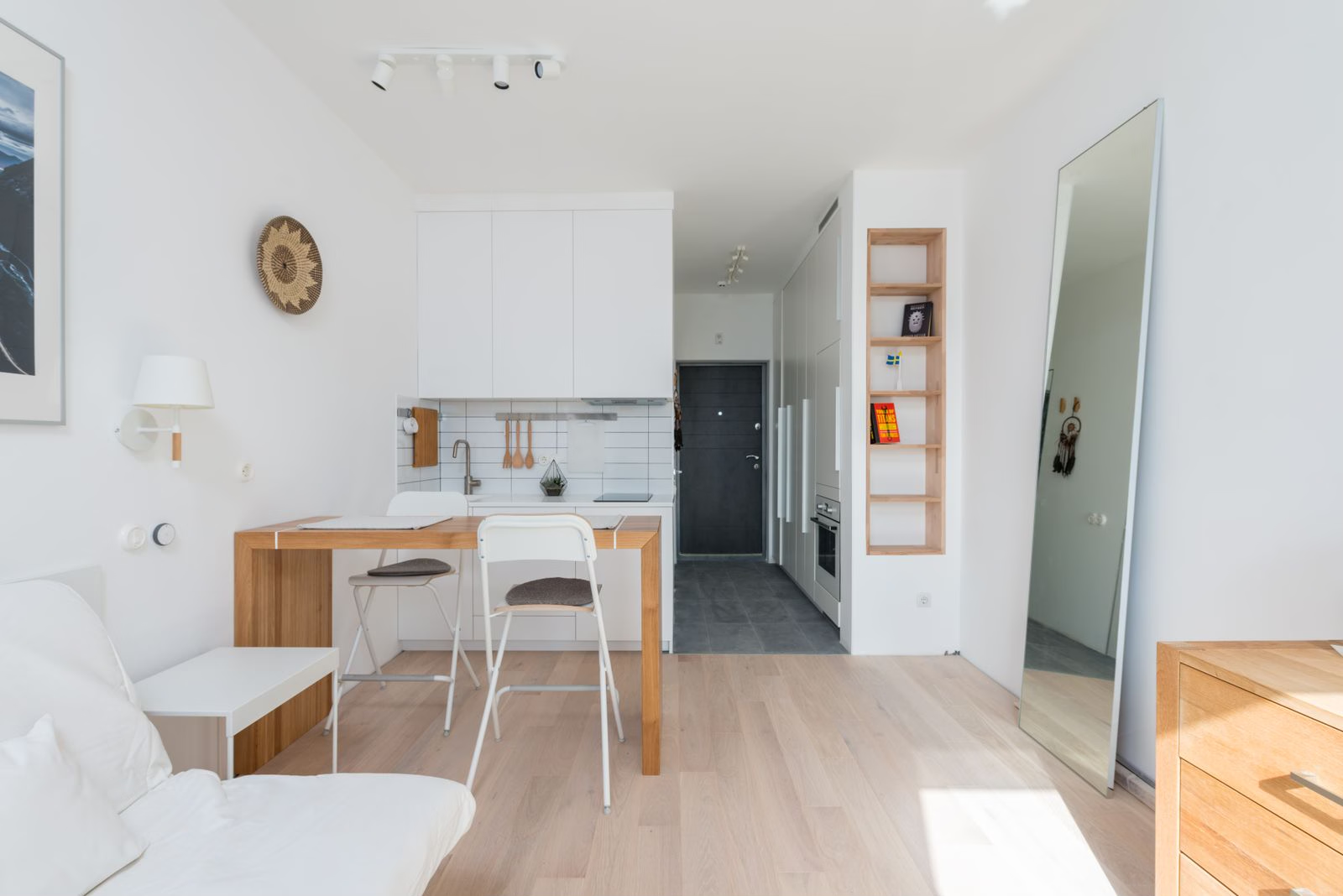
This rhythm changes the balance between delegation and self-management. A conventional home let by the year generates a one-off peak of activity around lease renewal; a student studio concentrates several of these peaks into a few weeks each summer, just when local rental demand is at its highest and when each week of vacancy costs proportionally more on a short lease. It is a context in which an agency's local support (sourcing applicants, handling guarantee files, quick turnaround on refurbishment between two tenants) clearly gains in value. It is also, conversely, a context in which a landlord managing alone has every interest in organising their follow-up in advance rather than rebuilding a tenant application file from scratch every autumn.
A third way: the hybrid model
Between full delegation and complete self-management, some landlords opt for an intermediate solution: entrusting an agency with the tasks that require a local presence or specific expertise (finding a tenant, inventories, handling a claim) while keeping control of day-to-day follow-up (payments, receipts, filing charges) through a personal tool. This approach keeps the commission down, as it is often lower when it covers a one-off assignment rather than a full management mandate, while keeping a local safety net for the moments that need it most.
This hybrid model does, however, require the same discipline as full self-management for the part you keep: without a tool to centralise what remains your responsibility, the risk of double handling (one document at the agency, another in your own file) quickly cancels out the intended benefit. Here again, a single tracking space, even for the part delegated upstream (signed lease, completed inventory), simplifies coordination between the two parties.
The real deciding factor
Between these two options, the right choice does not rest on a general rule but on a few practical questions to ask yourself honestly.
How much time am I prepared to spend on my rental property each month? A well-managed home takes on average a few dozen minutes a month in normal times (payment tracking, receipt), but with heavier one-off peaks: a change of tenant, the annual review, preparing the tax return.
Do I live near the property, or can I rely on someone I trust locally? Distance fundamentally changes the equation, especially for anything relating to inventories or a technical emergency.
How many properties do I have to manage, and is that number likely to grow? One home, two homes, a small portfolio: the tipping point towards delegation, or towards a more structured tool, often lies around this parameter.
What share of my return am I prepared to give up in exchange for free time? A 7% management commission on rent of €700 amounts to €49 a month, or nearly €600 a year, an amount to weigh against the time actually saved and the peace of mind gained.
There is no wrong answer to these questions, only an honest one. A landlord with a single studio in the town centre, who enjoys direct contact with their tenant and has a little time each month, will probably find more value in well-equipped self-management than in a monthly commission. A landlord with several properties spread across different towns, or who does not live in the region, will on the other hand gain from entrusting this workload to an agency that knows the area.
A few pointers to help you decide faster, depending on the profile closest to yours:
- A single property, close to home, with time available each month: well-equipped self-management is often the most profitable choice.
- Several properties, or a property far from where you live: delegating to a local agency limits friction and the risk of oversights.
- A student property with high turnover, but a landlord available for day-to-day follow-up: the hybrid model (agency for finding tenants and inventories, personal tool for the rest) is often the most balanced.
- A strong appetite for paperwork and a wish to keep direct contact with your tenants: self-management, whatever the number of properties, remains an option provided you are well equipped.
In summary
Property management is neither an administrative detail to be played down nor an insurmountable burden to be escaped at all costs through delegation. It is a fully fledged part of buy-to-let investment, which deserves to be planned before the purchase rather than discovered afterwards. Whether you choose to entrust it to a local agency or take it on yourself with the right tools, the essential point remains the same: never let the follow-up of the lease, the rent and the documents become a blind spot in your investment.
If you are still unsure about a property in Saint-Clément-de-Rivière, Montferrier-sur-Lez, Saint-Gély-du-Fesc or a neighbouring town, we can tell you in a single meeting exactly what a property management mandate with Alpaca Immobilier would cover, and what you can reasonably keep in your own hands.