The first question families ask us when viewing homes north of Montpellier is almost never the price per square metre. It is: "how long does it take to get into the centre in the morning?" A fair question, and the answer is more nuanced than it seems. Between Saint-Clément-de-Rivière, Montferrier-sur-Lez, Prades-le-Lez and Saint-Gély-du-Fesc, transport links vary enormously from one town to the next. Here is an honest overview, up to date as of summer 2026, so you know what to expect before buying.
What line 5 has changed in the north
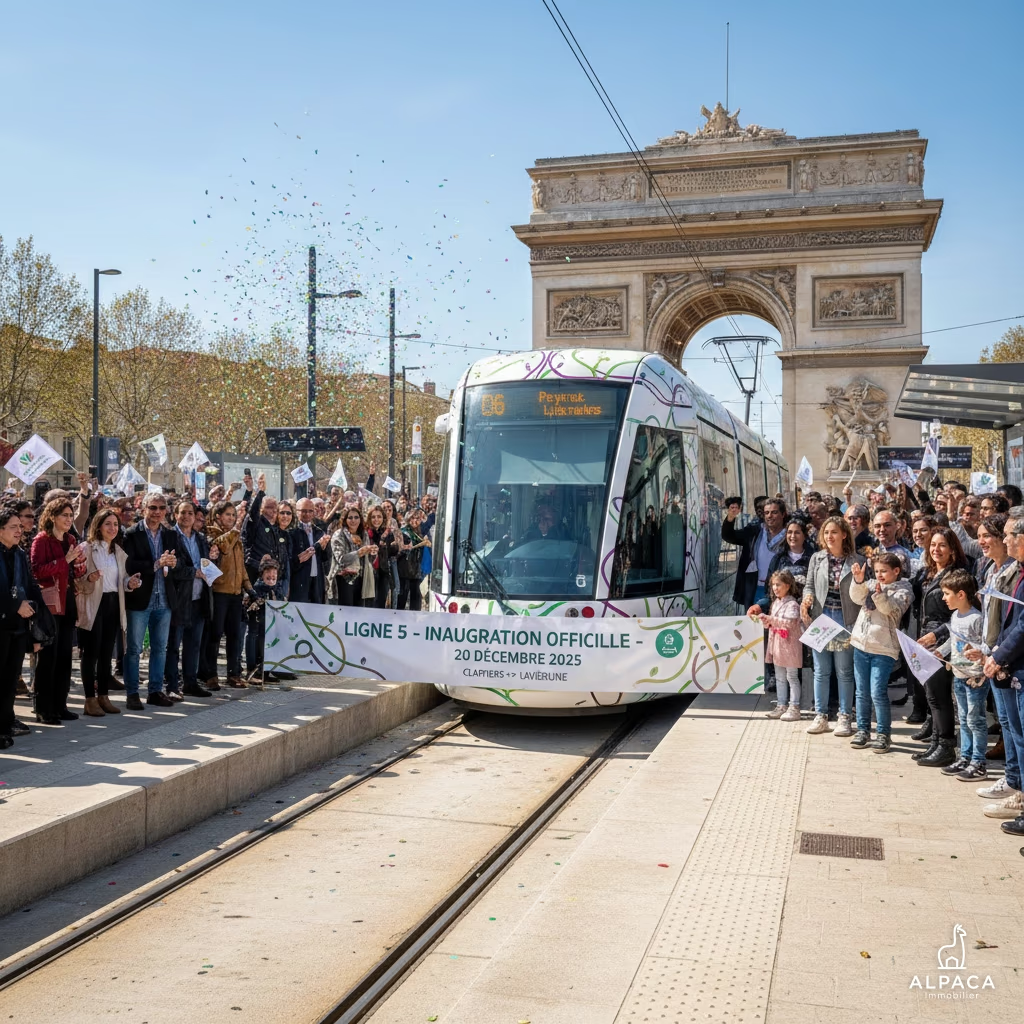
Opened on 20 December 2025, tram line 5 has redrawn the transport map in the north of the metropolitan area. At 16.3 kilometres long with 27 stops, it links Clapiers in the north to Saint-Jean-de-Védas in the south-west, passing through the university campuses and several residential neighbourhoods that were previously poorly served.
A key point to understand: the tram does not go up as far as Saint-Clément-de-Rivière or Saint-Gély-du-Fesc. Its northern terminus is at Clapiers, and the line serves Montferrier-sur-Lez on the way. These two towns now have direct access to the network, which was not the case just two years ago. For the whole area further north, the tram remains a connection to reach, not a stop on your doorstep.
The Clapiers terminus, a new gateway
The Clapiers terminus was designed as an interchange. A park-and-ride has been built there (around 450 spaces, expandable), with charging points and CCTV. It is free for holders of the metropolitan free-travel pass, a real advantage since TaM public transport is free for residents of the metropolitan area. At Clapiers, the tram connects with bus routes, including route 23 serving Prades-le-Lez, as well as regional lines.
In practice, a resident of Clapiers or Montferrier-sur-Lez can reach the heart of Montpellier without a car in around thirty minutes, depending on the starting point. It is a change of status for these towns, and an argument we now see carrying weight in purchase discussions.
Saint-Clément-de-Rivière and Saint-Gély: the car and liO buses
It needs to be said clearly: Saint-Clément-de-Rivière and Saint-Gély-du-Fesc are not part of Montpellier Méditerranée Métropole. They left it in 2004 and come under the regional liO network (Hérault Transport), not TaM. Free metropolitan travel therefore does not apply there.
Saint-Gély-du-Fesc is linked to Montpellier by liO's scheduled route 608, supplemented by an on-demand transport service within the town. Saint-Clément-de-Rivière is also served by regional liO lines towards Montpellier. Frequencies and timetables are those of an intercity network, less frequent than an urban tram line: we advise you to check the exact route and frequencies on the liO Occitanie website before committing, as the experience varies a great deal depending on your street and your working hours.
Reaching the tram without living on the line
For most households in these towns, the realistic option combines the car as far as an interchange, then the tram. The Clapiers park-and-ride makes this easier than before: you park at the terminus and finish by tram, avoiding the traffic and parking in Montpellier. Prades-le-Lez, which is part of the metropolitan area, has bus route 23 to the Clapiers terminus, a direct connection to line 5.
The road remains central: the LIEN and the car
In the north, the car remains the dominant mode of transport, and road infrastructure matters as much as public transport. The major project in the area is the LIEN (Liaison Intercantonale d'Évitement Nord), the dual carriageway bypassing the north of Montpellier. Its final section, between Saint-Gély-du-Fesc and Bel-Air (towards the A750), is expected in 2026 and should ease roads that are currently gridlocked at rush hour.
For towns not served by the tram, this project carries a lot of weight: it determines the daily journey time to the west of the conurbation and to the motorway. Car-sharing, encouraged by several car parks along these roads, rounds out the options for those who work the same hours as their neighbours.
Cycling is gaining ground
The terrain in the north is not flat, but cycling infrastructure is improving. The banks of the Lez offer a pleasant and safe route into Montpellier, and the arrival of the tram has come with new continuous cycle routes, including a cycle link between Montferrier-sur-Lez and line 5. Electric bikes change the equation for home-to-tram journeys, taking the sting out of the hills that many people dreaded. For a commuter who cycles to the terminus and then takes the tram, the journey time becomes very competitive with driving all the way.
Accessibility and value: what we observe
Accessibility is not just a matter of comfort: it directly affects a property's value. A house ten minutes' walk from a tram stop cannot be compared with an isolated house that depends entirely on the car, even in the same town. Since line 5 opened, we have noticed that proximity to the Clapiers terminus and the Montferrier-sur-Lez stop has become an explicit criterion for buyers, particularly families with independent teenagers and people working in the city centre.
For towns outside the tram network, the argument shifts: road access, quality of life and progress on the LIEN take over. None of these areas is undervalued; they simply suit different profiles. Our role is to put these realities on the table rather than oversell them.
If you are wondering how the transport links on your street translate into price, that is exactly the kind of analysis we carry out during a valuation: we look at the real time to the tram, exposure to future developments and the demand specific to each town. A price per square metre means nothing if it ignores the way you live and travel day to day.