Hérault and Gard were placed on red rain and flood alert on Wednesday 30 September 2026. Schools are closed, trams have stopped and water has reached cellars and ground floors in Montpellier as well as in the surrounding towns. When the home affected is a rental, one question comes up as soon as the water recedes: who covers what, between the tenant, the landlord and their respective insurers?
We manage homes in Montpellier, Saint-Clément-de-Rivière, Le Crès and the surrounding towns. Here we set out what we explain to our tenants and our landlords, in the order in which things happen.
During the event: safety before belongings
While the alert is in force, no object is worth going out for.
- Do not go down to the cellar or the underground car park, even to move the car. That is where most accidents happen.
- Do not drive. Thirty centimetres of water is enough to sweep a vehicle away.
- If water gets into the home, switch off the electricity and gas, then go upstairs with your papers, your medication and a charged phone.
- In an emergency, call 112 or 18.
The Météo-France and Vigicrues maps are updated continuously.

As soon as the water recedes: gather the evidence
Compensation depends on what you can show. Before cleaning anything:
- Photograph and film every room, then every damaged item, including the line the water reached on the walls.
- Do not throw anything away before the loss adjuster's visit or the insurer's written consent. If an item has to go for hygiene reasons, photograph it from several angles first.
- Draw up a list of the items affected and gather whatever proves their value: invoices, bank statements, order confirmations, earlier photos.
- Limit further damage (ventilate, raise furniture, pump out water if it can be done safely) and keep the invoices for these expenses.
- Notify your landlord or managing agent the same day, in writing, with the photos.
Do not start repair work before the insurer has assessed the damage: only emergency measures are expected of you.
Storm or natural disaster: two types of cover, two timetables
Damage from a Mediterranean storm event (épisode méditerranéen) is split between two types of cover, depending on its cause.
The effects of the wind (roof tiles torn off, a fallen tree, a shutter blown away, rain coming in through a damaged roof) fall under storm cover (garantie tempête), included in every home insurance contract that covers damage to property. It applies without any official order. The law requires the contract to give you at least five working days to report the claim.
The flooding itself (a river bursting its banks, surface run-off, mudslides, rising groundwater) falls under natural disaster cover (garantie catastrophes naturelles). It only applies if an interministerial order (arrêté), published in the Journal officiel, recognises a state of natural disaster for the town and period concerned. Town halls apply for this through the prefecture. You then have 30 days from publication of the order to file your claim.
We advise you not to wait for the order. Report the claim to your insurer now, through its app, your online account or by recorded delivery letter: your file will already be open and dated on the day of publication.
What the tenant's insurance covers
Tenants are legally required to insure the home against tenant's risks (risques locatifs). This minimum cover protects their liability towards the landlord (fire, explosion, water damage they may have caused). It does not cover their own belongings.
For your belongings to be compensated, you need a comprehensive home insurance policy (multirisque habitation) that covers contents. That is the case for the vast majority of policies, but not for entry-level policies limited to tenant's risks. A quick look at your policy schedule (conditions particulières) will tell you.
With comprehensive home insurance, your insurer compensates:
- your furniture, household appliances, clothes and personal belongings;
- improvements you made yourself (paintwork, fixed shelving, a kitchen you installed);
- the contents of the cellar or garage, within the limits set out in the contract;
- your emergency rehousing costs, in a recognised natural disaster, if your main residence is uninhabitable. This cover can last up to six months.
In a natural disaster, a statutory excess of €380 remains payable by you. It cannot be bought back.
Your vehicle depends on your car insurance, not your home insurance. It is only compensated if the policy includes damage cover (comprehensive, fire, theft or glass breakage). Basic third-party insurance does not cover a flooded car.
What falls to the landlord and their insurance
The building belongs to the landlord, so it is their insurance that repairs it. In a co-owned building (copropriété), non-occupying owner's insurance (assurance propriétaire non occupant, PNO) is compulsory. It covers:
- walls, floors, ceilings, doors and windows;
- the home's fixtures and fittings: boiler, water heater, fuse board, the kitchen and bathroom provided;
- in a furnished let, the furniture and appliances provided by the landlord, provided the policy covers contents.
Common areas (entrance hall, cellars, car park, lift, roof) fall under the building's insurance, with the claim made by the managing agent (syndic).
The tenant does not have to bear these repairs. The law of 6 July 1989 makes tenants liable for damage occurring during the tenancy, except where it results from force majeure, which a flood is. The landlord therefore cannot deduct the cost of repairs from the security deposit (dépôt de garantie).
Tenant and landlord therefore each file a claim on their own side, with their own insurer, for what belongs to them. The two files proceed in parallel.
What nobody covers
A few situations leave you out of pocket, and it is better to know about them in advance:
- the belongings of a tenant insured for tenant's risks only;
- a vehicle with basic third-party cover;
- items stored in a cellar or basement beyond the ceiling that many contracts set for these spaces;
- the statutory excess, which is always deducted;
- belongings whose existence or value cannot be established.
Without a natural disaster order, flooding from run-off or a river bursting its banks is not compensated under this cover. Some contracts include separate flood cover: reread yours.
And the rent, if the home is damaged?
The rent remains due as long as the home is habitable, even with defects. The Civil Code then provides for three situations:
- If the home is destroyed or totally uninhabitable, the lease is terminated automatically, without notice. Rent stops on the day of the disaster and the security deposit is returned. The landlord is required neither to rebuild nor to rehouse.
- If the home is partly unusable, the tenant can request a reduction in rent or termination of the lease.
- If urgent works last more than 21 days, the rent is reduced in proportion to the duration and to the part of the home the tenant is deprived of.
As long as the lease continues, do not stop paying on your own initiative. A reduction must be agreed in writing with the landlord or their managing agent. ANIL sets out these rules and the local housing information agencies (ADIL) give free advice.
Getting properly compensated: the points that make the difference

- Report early and in writing, keeping proof of sending.
- Cost things precisely: a dated, item-by-item list with supporting documents carries more weight than an overall estimate.
- Be present at the loss assessment and reread the report before signing it. You can dispute a valuation and request a second assessment.
- Ask for an advance payment. In a natural disaster, the insurer must pay an interim amount within two months of receiving your estimate of losses or of the order's publication, then the balance of the compensation within three months of the same date.
- Keep all invoices: pumping, dehumidifier, furniture storage, hotel nights.
In summary
| Item or expense | Who files the claim | Which insurance |
|---|---|---|
| Tenant's furniture and personal belongings | The tenant | Their comprehensive home insurance |
| Walls, floors, boiler, kitchen provided | The landlord | Their non-occupying owner's insurance |
| Furniture in a furnished let | The landlord | Their insurance, if contents are covered |
| Common areas, roof, car park | The managing agent (syndic) | The building's insurance |
| Car | Its owner | Car insurance, with damage cover |
| Tenant's emergency rehousing | The tenant | Their comprehensive home insurance, in a natural disaster |
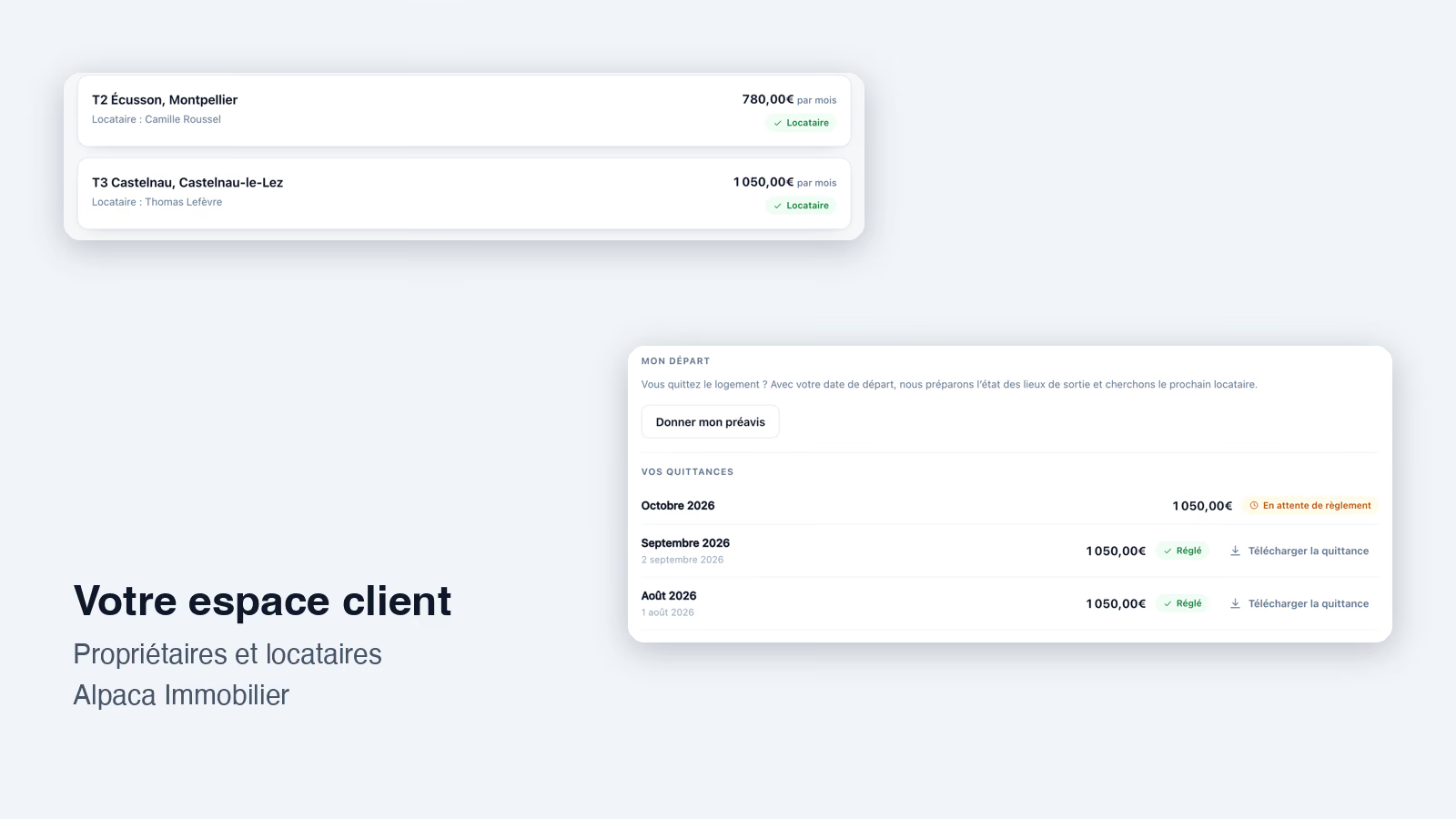
If your home is managed by Alpaca Immobilier, report your damage from your client area, Assistance tab, with photos. We remain on hand for our tenants and will do our best in every situation. Owner-occupiers, our article on fallen trees and flooded houses around Montpellier covers your situation. And if you would like to entrust us with a property, our property management service takes care of these procedures.