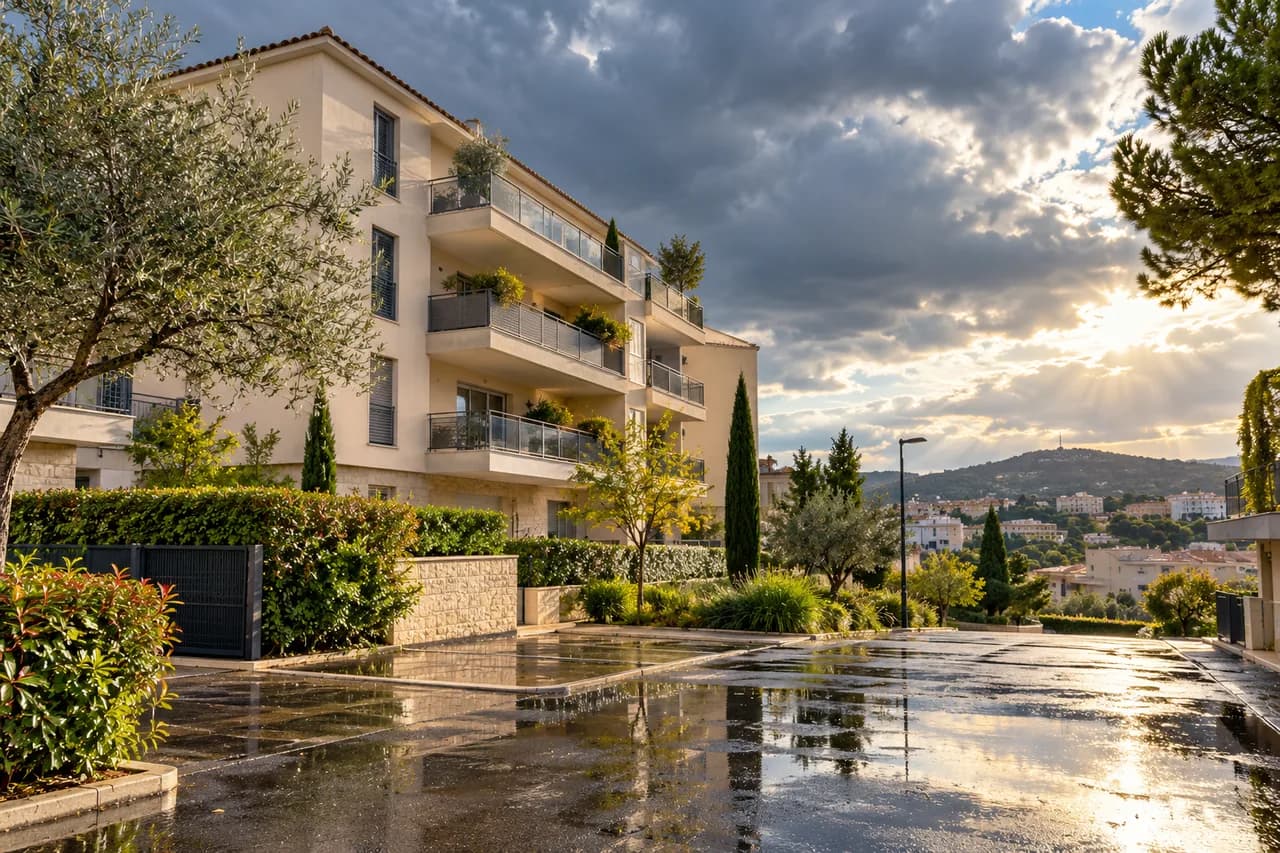
A co-ownership building (copropriété) in the Hérault handles weather-related damage by first making the building safe, then having the damage assessed and promptly reporting the claim to the relevant insurer. The managing agent (syndic) coordinates repairs to the common parts, while each occupant or co-owner deals with their own insurer for the private property affected. Whether the damage is covered depends on its cause, the cover taken out and, for some floods, an official natural disaster order (arrêté de catastrophe naturelle).
Preparing for storm episodes reduces material damage and disruption to the use of the building.
In a department prone to Mediterranean storm episodes (épisodes méditerranéens), it is worth rereading the co-ownership insurance policy before the rainy season: the scope of insured common parts, storm and hail cover, electrical damage, ceilings and excesses should all be reviewed together. This check avoids discovering an exclusion just when a roof, an underground car park or a lift has been damaged.
Assurance-Coproprietes.fr provides information on building insurance and a quote comparison service. For the co-owners' council (conseil syndical), the practical benefit is having points of comparison for equivalent cover, without confusing the cost of the premium with the protection actually bought.
Storm, hail, flood: which cover applies?
In Montpellier, Béziers, Sète or the hinterland, a single storm episode can cause several types of damage: tiles torn off, glass roofs shattered, water getting in through damaged roofing, run-off into garages or a river bursting its banks. The National Housing Information Agency (Agence nationale pour l'information sur le logement, ANIL) points out that the applicable cover depends on how the damage occurred, not just on the weather forecast. You therefore need to describe precisely how the water or wind reached the building.
Wind, hail and rain: distinguishing the event from its consequences
Damage directly caused by wind falls in principle under storm cover, where it is included in the policy. Hailstones striking tiles, glass roofs or roofing elements may fall under hail cover or storm-hail-snow cover, depending on the policy wording. Rain that came in through a roof damaged during the storm is not the same as water rising from the street. Processing times, the equipment covered and proof of the event's intensity can differ: the insurer may in particular ask for dated photos or weather data.
Flooding: a natural disaster order changes the rules
When a flood, mudslide or intense run-off is of abnormal intensity and is officially recognised, natural disaster cover (garantie catastrophes naturelles) can apply to property covered by damage insurance. According to Service-Public.fr, the interministerial order published in the Official Journal (Journal officiel) specifies the municipalities, the dates and the nature of the recognised event. A flooded basement is therefore not automatically compensated under this scheme: you need to check the municipality concerned, the recognised event and the property actually insured.
Pointers for directing the claim:
| Situation observed | Cover to examine | Check point |
|---|---|---|
| Tiles torn off by the wind | Storm | Policy conditions and proof of damage |
| Glass roof or roofing struck by hail | Hail / storm-hail-snow | Equipment included, exclusions and excesses |
| Garages submerged by a flood | Natural disasters | Order published and property insured |
| Pipe leak after bad weather | Water damage, depending on the policy | Origin of the leak and liability concerned |
Finally, the co-ownership's collective policy must be distinguished from individual policies. Article 9-1 of the law of 10 July 1965 requires the owners' association (syndicat des copropriétaires) and each co-owner to hold third-party liability insurance. Comprehensive building insurance (multirisque immeuble) is designed to protect the building according to its cover; it does not systematically replace insurance for the flats or their contents.
Who reports the claim and within what time limits?
The managing agent reports damage to the common parts to the building's insurer: roofing, façade, stairwell, shared gate, plant room or shared installation. For private parts and personal belongings, owner-occupiers, landlords or tenants notify their respective insurers according to their policies. Even if the damage originates in the common parts, it is wise to report the claim promptly on both sides so that the files can be coordinated.
For an ordinary claim, such as storm or hail, article L. 113-2 of the Insurance Code (Code des assurances) provides that the contractual deadline for reporting cannot be less than five working days after becoming aware of the damage. In the case of a recognised natural disaster, the claim must be made as soon as possible and no later than 30 days after the order is published in the Official Journal. There is no need to wait for that publication before photographing the damage or notifying the insurer: the initial information can be sent immediately and then supplemented.
The file sent by the managing agent should bring together the elements that will allow the loss adjuster to tell a sudden event from long-standing lack of maintenance:
- time-stamped photographs, the location of the damage and a timeline of events;
- the policy references, statements from occupants and, where available, call-out reports;
- quotes for making the building safe, invoices, proof of value and damaged items kept;
- decisions taken as a matter of urgency and correspondence with the insurer or loss adjuster.
Protecting people remains the priority. Do not enter a flooded car park or switch back on an electrical installation that has been in contact with water. Article 18 of the law of 10 July 1965 allows the managing agent, in an emergency, to have the work needed to safeguard the building carried out on their own initiative. A temporary tarpaulin, safe pumping out or taking a lift out of service can thus come before the final repairs.
The excess: something to know before the storm
The excess (franchise) is the amount left for the policyholder to pay after the insurer has paid out, before any other policy limits. For contractual cover such as storm or hail, its amount and any proportional calculation are set out in the policy. Two quotes with the same annual premium can therefore leave very different amounts to pay when a roof has to be redone.
For the statutory natural disaster cover, Service-Public.fr and the ANIL state an excess of €380 for residential or non-business property, with a separate regime for certain other property and an amount of €1,520 for ground movement linked to drought or soil rehydration. The co-owners' council should check which excess actually applies to the collective policy and to the category of property concerned, rather than automatically transposing a rule read for an individual flat.
Beyond the excess, you need to check compensation ceilings, repair deadlines, depreciation for wear (vétusté), leak detection costs, pumping, clearing debris and any loss adjuster fees that may be covered. Compensation below the actual cost of the works can lead to an exceptional call for funds. The minutes of the general meeting must then set out the expenses incurred and how they are shared under the co-ownership regulations (règlement de copropriété).
Preparing the building for the next episodes
Prevention starts well before Météo-France issues its weather warnings. Mediterranean storm episodes can concentrate very heavy rainfall over a short period; in a building, water first finds the weak points: a terrace with a blocked drain, worn joints, cluttered gutters, a garage entrance below street level or an unprotected basement window. The maintenance log (carnet d'entretien) is as useful a monitoring tool as the insurance policy.
From routine maintenance to an action plan
The managing agent and the co-owners' council can schedule inspections of the roof, downpipes and inspection chambers before the most exposed periods, then record the work done. Electrical equipment and plant rooms located in the basement deserve particular attention. Where the layout justifies it, flood barriers, non-return valves or door protections can be studied by professionals, without diverting water onto a neighbouring property.
Occupants should also know what to do in the event of an orange or red warning: avoid unnecessary journeys, do not go down into flooded basements and follow official instructions. The Vigicrues, Météo-France and Géorisques tools, together with the municipal information document on major risks (document d'information communal sur les risques majeurs, DICRIM), complete this set-up, while the flood risk prevention plan (plan de prévention des risques d'inondation, PPRI), where one exists, sets out local constraints.
Voting on works and keeping records
A survey of waterproofing, drainage or raising certain equipment out of the water's reach can be placed on the agenda of the general meeting. The multi-year works plan (plan pluriannuel de travaux), where required, makes it possible to prioritise operations, and the works fund (fonds de travaux) can help finance eligible expenses under the conditions laid down by law. Before-and-after photos of works, maintenance contracts and invoices will be useful if a future claim leads to an assessment: they show the measures taken to preserve the building.
What the buyer of a flat can check
For a buyer in the Hérault, the climate question should be part of the analysis of a property in the same way as the condition of the roof, energy performance or service charges. A bright flat near a river, on the coast or on the ground floor can have real advantages, but also exposure to run-off, rising water or strong winds. The aim is not to rule out an address systematically, but to put a figure on the risks and possible works before committing.
Reading the documents before the preliminary sale agreement
The risks report given to the buyer identifies certain regulatory exposures and disclosure obligations. The public Géorisques service provides access, from the address, to hazard data and to information procedures for buyers and tenants. It is worth supplementing this reading by visiting the car parks after rain, looking for signs of damp and, if necessary, asking the managing agent about previous claims.
Service-Public.fr points out that the buyer of a unit in a co-ownership receives in particular the minutes of the general meetings for the last three years, the maintenance log, financial information, and the multi-year works plan or its draft where they exist or are required. These documents may reveal postponed roof repairs, an ongoing assessment, a disputed insurance payout or a call for funds already being considered. Asking about the excess on the collective policy is also relevant, as the final cost of a weather episode does not stop at the amount reimbursed by the insurer.
Anticipating the real cost of ownership
A buy-to-let investor will look at non-occupying owner's insurance (assurance propriétaire non occupant), arrangements for possibly rehousing the tenant and the consequences of a home that is temporarily unfit for habitation. For an owner-occupier, attention will focus more on protecting contents, assistance cover and access to the building after a storm. In both cases, the budget must include current service charges, future works already voted and a margin for uncompensated expenses.
A co-ownership that keeps proof of maintenance, monitors its local risks and clearly explains its claims history gives the buyer concrete information on which to decide. This transparency also eases discussions with the notary, the managing agent and the insurer before signing, rather than leaving roof or flooding questions to surface after the purchase.