
Handing an agency the sale of your house, the management of your property or the search for your first home in France means trusting it with money, personal documents and a binding contract. France has regulated this profession since 1970, and here is the good news: every one of those obligations can be verified online, for free, in a few minutes. These are the 8 checks we recommend to any seller, buyer or tenant before signing anything.
What makes a French agency trustworthy, in short
In France, a reliable agency leaves a paper trail you can verify yourself: a "carte T" (the professional licence required to broker sales and rentals), issued by the chamber of commerce under the "loi Hoguet" (the 1970 law that governs French real estate professionals); a financial guarantee of at least €110,000 whenever it handles client money; valid professional liability insurance; a consumer ombudsman registered with the French State; a clean entry in the national business register; a fee schedule published on its website, taxes included; an up-to-date register of its agency agreements; and anti-money-laundering checks it actually carries out. None of this rests on the agency's word: every point can be cross-checked against a public database. A serious agency hands over these documents without being asked twice. The one that dodges the question has already told you everything you need to know.
1. The "carte T", the cornerstone of the loi Hoguet
Nobody in France may sell or rent out property on someone else's behalf without a professional licence. The loi Hoguet of 2 January 1970 makes it mandatory: the "carte T" for sales and lettings, the "carte G" for property management. The licence is issued by the local chamber of commerce and industry (CCI), renewed every 3 years, and conditional on professional qualifications, a clean record and insurance. Operating without one is not a technicality - it is a criminal offence punishable by 6 months in prison and a €7,500 fine.
Where to check: the public register of licensed real estate professionals kept by the CCIs. Type in the agency's name: its licence number, validity and authorised activities come straight up.
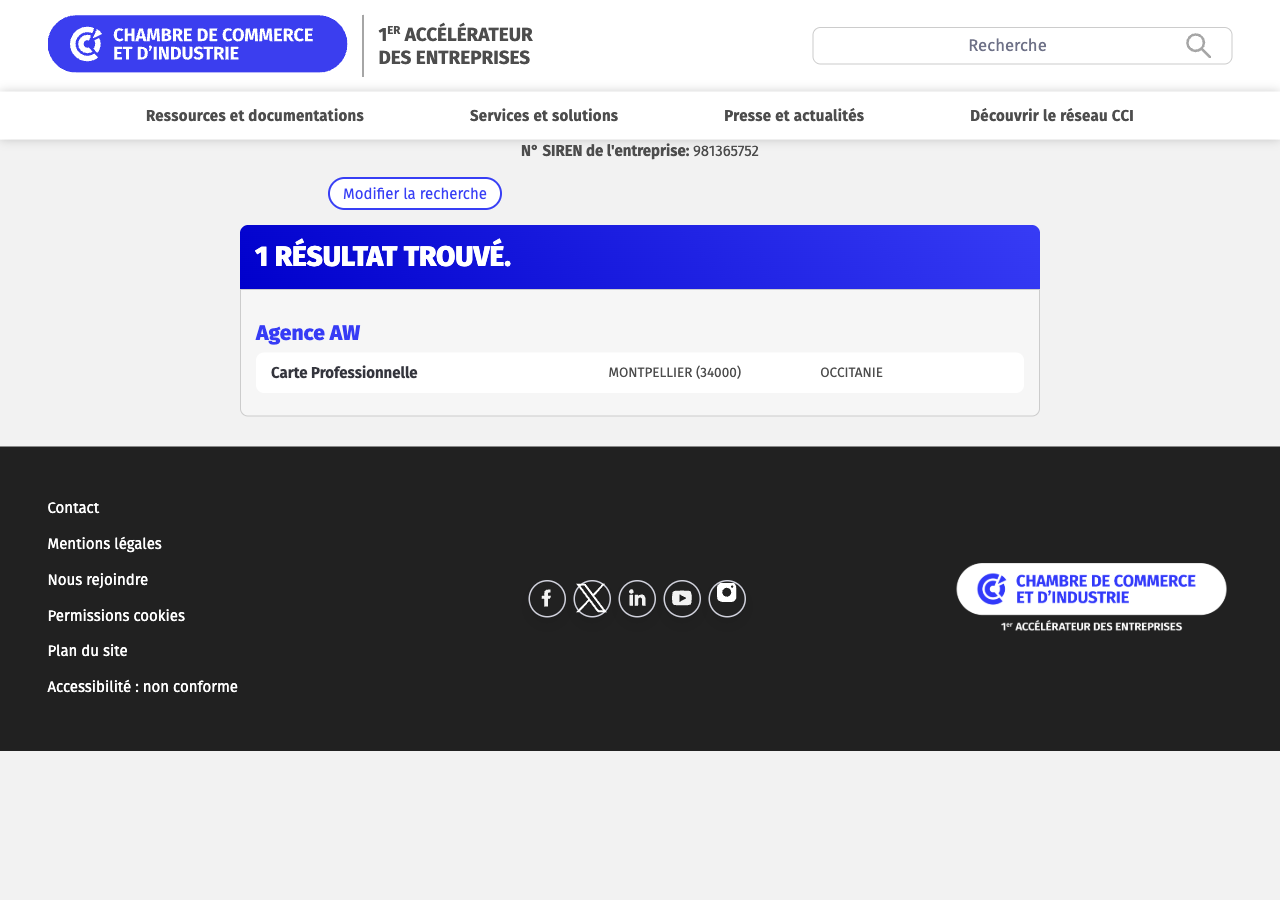
What you gain: the certainty that the agency has proven its competence to the authorities, that it is insured, and that the CCI can withdraw its licence at the first serious breach. An agency missing from this register simply has no right to operate.
2. The financial guarantee that protects your money
The moment an agency holds money on your behalf - the escrow deposit on a purchase agreement, a tenant's security deposit, rent it collects - it must carry a financial guarantee of at least €110,000, backed by a specialist guarantor such as Galian-SMABTP or SOCAF, or by a bank. If the agency ever fails, that guarantor refunds your money. One caveat: some licences carry the mention "sans détention de fonds" ("not authorised to hold funds"). The agency may operate, but you should never hand it a single euro - everything goes through the notaire or directly between the parties.
Where to check: the guarantor's name appears on the agency's entry in the CCI register mentioned above. It must also appear on your agency agreements, in the legal notices of the website and on the display in the agency's window or online.
What it means in practice: even if the agency goes bankrupt or defrauds you, the money you entrusted to it does not go up in smoke.
3. Professional liability insurance
A survey report passed on incorrectly, a cooling-off period notified late, a floor area copied onto the lease without checking: mistakes like these are expensive, and not always for the agency. That is why French law requires every licence holder to carry professional liability insurance ("assurance RCP"), which compensates clients harmed by an agency's error.
Where to check: ask for a current insurance certificate. Providing it is one of the professional's legal obligations, and any agency has it at hand - ours emails it the same day.
In practice: if a mistake by the agency causes you a loss, a solvent insurer picks up the bill, whatever the state of the agency's cash flow that month.
4. The consumer ombudsman
Since 2016, every professional selling to consumers in France must belong to a consumer mediation scheme (article L612-1 of the French Consumer Code). If a dispute is still unresolved after a written complaint, you can refer it to this ombudsman free of charge, before going anywhere near a court. The ombudsman's name and contact details must appear on the agency's website and contractual documents.
Where to check: the official list of registered ombudsmen published by the French Ministry of the Economy. Make sure the ombudsman the agency names is actually on it.
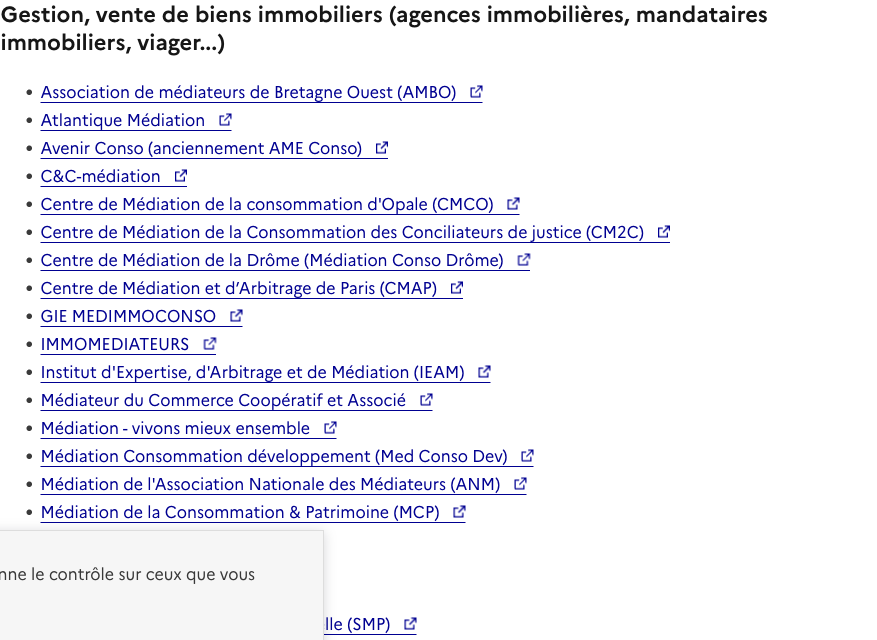
The benefit: a free, State-supervised recourse for the day the conversation with the agency breaks down.
5. Company registration and financial health
An agency is first and foremost a company. Its age, its directors, its capital, any insolvency proceedings such as receivership or liquidation: all of it is public. Five minutes of reading tell you more than the glossiest brochure.
Where to check: the Annuaire des Entreprises, the French government's official company directory. Search the agency's name or SIREN number (its unique company ID) and you get its founding date, directors, official journal announcements and any ongoing proceedings.
Why it matters: you know exactly who you are entrusting your project to. A company in liquidation that keeps signing new clients shows up here - not in its shop window.
6. The fee schedule, published and easy to find
French agencies set their fees freely. Displaying them, however, is not optional. A regulation of 10 January 2017, amended in 2022, requires every agency to publish its full price list, taxes included, in the agency and on its website, and to make it accessible from any page showing property listings. A fee schedule that is nowhere to be found, or buried at the bottom of the site, is a breach of the rules - and very often the sign of fees made up on the spot depending on the client.
Where to check: on the agency's website, the fee schedule should be at most 2 clicks away. The DGCCRF's practical guide to real estate professionals' obligations (the DGCCRF is the French consumer protection authority) details all the display and advertising rules.
What it changes for you: fees you know before committing, comparable from one agency to the next, and no surprise line item slipped in at signing time.
7. The register of agency agreements and anti-money-laundering checks
Every "mandat" (the written agreement authorising an agency to sell or let a property) must be entered chronologically in a numbered register. Without a registration number, the mandat is void and the agency is entitled to no fee at all. Agencies are also among the professions covered by France's anti-money-laundering framework (the TRACFIN system): they must identify their clients and question the origin of funds.
This point often takes our clients by surprise - in the opposite direction. When an agency asks you for ID, proof of address or the source of your down payment, it is not being overzealous: it is applying the French Monetary and Financial Code. It is a mark of seriousness, not an intrusion.
Where to check: the register number must appear on your copy of the mandat. As for the anti-money-laundering side, judge the agency by its behaviour: the one that asks you nothing is the one that should worry you.
The result: legally solid agreements, and an agency that filters out dubious transactions - including the ones where you would be the victim.
8. Client reviews, read with method
Online reviews are still useful, provided you cross-check them. A rating on its own proves nothing, and fake reviews - bought, or written by friends and family - remain a sanctioned practice that the DGCCRF actively hunts down. A few habits that hold up: compare several platforms (Google, local directories, social media), read the negative reviews first and above all the agency's replies, be wary of bursts of praise posted the same week, and look for reviews that describe a real situation - a sale, a rental, a managed property - rather than vague generalities.
Where to check: the DGCCRF's guidance on fake consumer reviews, and SignalConso to report a misleading practice or browse the reports already filed.
What it reveals: the real client relationship behind the headline rating. An agency that answers an unfair review calmly tells you more than an agency rated 5/5 without a single detailed comment.
The red flags that should make you walk away
Red list: stop everything if you spot any of these.
- The agency cannot be found in the CCI register of professional licences.
- It refuses to send you its insurance certificate or the name of its financial guarantor.
- It asks for a bank transfer to an account that is neither an escrow account nor a notaire's account.
- You are asked to pay anything before a viewing, or before the lease or purchase agreement is signed.
- No fee schedule is published anywhere, or the amounts shift from one conversation to the next.
- Your contact pressures you to sign "today, or the property is gone" without giving you time to read.
Any single one of these is reason enough to put the project on hold and run through the checks in this article, one by one.
International students and expats: your specific protections
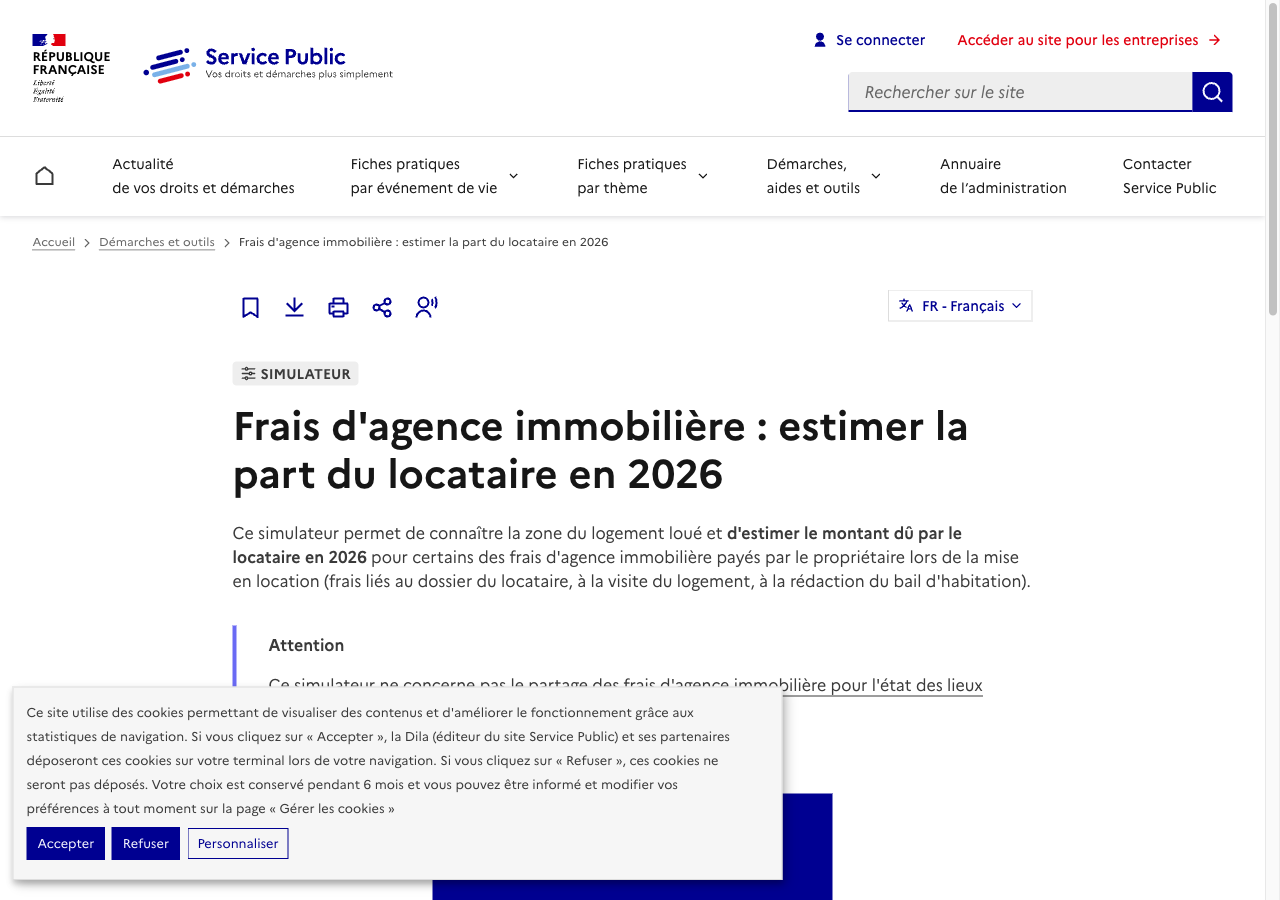
If you are arriving from abroad to study or work in Montpellier, you are a fraudster's dream target: you rent from a distance, you are new to French law and you are short on time. Start by memorising the legal caps. Montpellier is classed as a "zone tendue" (a high-demand area where rents and fees are regulated): since 1 January 2026, the fees an agency may charge a tenant are capped at €10.09 per m² of living space, plus €3.03 per m² for the move-in inspection ("état des lieux"). For a 20 m² studio, the bill can therefore never exceed €262.40. The official calculator on service-public.gouv.fr does the maths for you.
The security deposit is capped too: 1 month's rent excluding charges for an unfurnished rental, 2 months for a furnished one. And any payment demanded before the viewing or before the lease is signed is illegal, without exception. That is precisely how the fake-landlord scam works: an attractive listing, a "landlord living abroad" and a request for a wire transfer or cash voucher to "reserve" the apartment. Never pay to view a property. Never pay before you have signed a lease and verified the identity of the person in front of you.
Three official resources exist in English: the service-public guides on tenant-side agency fees and on the security deposit, and the Campus France guide on avoiding rental scams. We speak English, Spanish and Portuguese, and our relocation service exists precisely to support arrivals from abroad - verifications included.
And what about Alpaca Immobilier?
We could hardly publish this checklist without putting ourselves through it. So here are our own credentials, all verifiable on the public registers cited above:
| Check | Our credential |
|---|---|
| Professional licence | CPI 3402 2024 000 000 002, issued by the CCI de l'Hérault |
| Company registration | SIREN 981 365 752, RCS Montpellier |
| Financial guarantee and professional liability insurance | +Simple (insurer QBE) |
| Consumer ombudsman | Vivons Mieux Ensemble, on the official register |
| Fee schedule | Published on our about us page |
The details live in our legal notices, and our certificates go out on simple request, exactly as the law requires. A question about selling, buying or renting in Montpellier and the towns north of the city? Call us on 09 70 70 31 07 or write to us: we answer verification questions as gladly as we answer valuation requests.